
 All good things must come to an end. The same remains true for unfortunate things, too. Even A Series of Unfortunate Events must come to an end. With season 3, that’s exactly what the Netflix adaptation on the Lemony Snicket series does. The books are pretty notorious for their lack of any kind of real resolution or concrete answers to the mysteries presented throughout the series. So, with that in mind, how does the show handle the ending? The answer: much the same, but a bit different. Featuring a bit more resolution than what was found in the books, season 3 of A Series of Unfortunate Events brings the somewhat uneven series to a satisfying conclusion.
Season 3 of A Series of Unfortunate Events adapts the final four novels of Lemony Snicket’s acclaimed novels. The series follows the Baudelaire orphans – Violet (Malina Weissman), Klaus (Louis Hynes), and Sunny (Presley Smith / Tara Strong (voice)) – after they’ve suffered a terrible tragedy: the deaths of their parents and the destruction of their home. The orphans are sent to live with Count Olaf (Neil Patrick Harris), a villain who will stop at nothing to obtain their fortune. Their journey will take then into the wilderness of a snowy mountain, to the depths of the ocean, to a mysterious hotel, and all the way to a deserted island. There are no happy endings in this story, so what will become of the Baudelaire orphans?
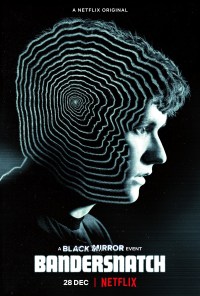 Choose-Your-Own-Adventures books are always a lot of fun. You’re able to explore multiple different endings to a story, some ridiculous, some serious, and you’re able to replay that story countless times to explore each different branch of the story. It’s a method of storytelling that’s never really been tried in film or TV before. Before Bandersnatch, that is. Bandersnatch is the first film in the Black Mirror series. Written by Charlie Brooker and directed by David Slade, Bandersnatch is a Choose-Your-Own-Adventure film that allows audiences to choose how the story of Stefan Butler (Fionn Whitehead) plays out. It’s a whole lot of fun and genuinely impressive to watch (and participate in). (NOTE: There will be spoilers for Bandersnatch. I will try to keep them minor, but it’s hard to talk about this film without spoiling some things.)
 On the bright side, it’s not awful. It’s not really all that good, either, though. Which is a shame since there’s really a lot of potential in the movie. And it’s even more frustrating since the movie is clearly set up for sequels that I’m not sure it’s gonna get considering the quality of this film. Death Note is Netflix’s latest original movie and is a somewhat loose adaptation of the Manga of the same name written by Tsugumi Ohba and illustrated by Takeshi Obata. In Netflix’s adaptation (written by Charles Parlapanides, Vlas Parlapanides, and Jeremy Slater and directed by Adam Wingard), the action is moved from Japan to Seattle and follows Light Turner (Nat Wolff), a bright student, stumbles across a mystical notebook (and the god of death that accompanies it, Ryuk (voice and facial motion capture by William Dafoe, physical actions by Jason Liles)) that has the power to kill any person whose name he writes in it. Light decides to launch a secret crusade to rid the streets of criminals. Soon, the student-turned-vigilante finds himself pursued by a famous detective known only by the alias L (Lakeith Stanfield). (As always, this will contain spoilers.)

 Thoroughly Modern Reviewer