

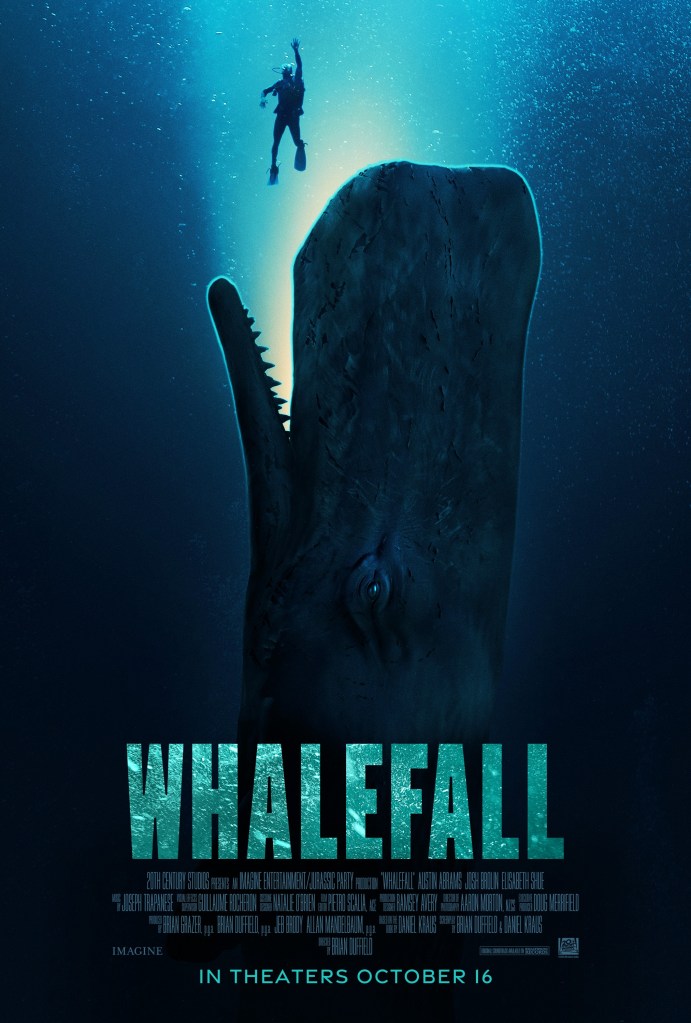
Following the death of his father (Josh Brolin), Jay Gardiner (Austin Abrams) goes diving off the central Coast of California in search of his remains, but is swallowed by a massive sperm whale. While trapped inside its belly with only one hour of oxygen left, Jay comes to realize that the hard-earned lessons his father imparted may be the key to his escape.
Welcome to Austin Abrams’ latest terrible, horrible, no good, very bad day. When last we saw him, he was single-handedly fighting off zombies in Raccoon City in Resident Evil. And now, he finds himself deep in the belly of a whale in Brian Duffield’s adaptation of Daniel Kraus’ bestselling novel, Whalefall. The film centers around a young man, Jay (Abrams), as he comes face to face with his regrets in the aftermath of his father’s (Brolin) suicide—all while, ya know, trying not to be digested by a massive sperm whale. And while that premise might sound a little hokey, like a wannabe Lifetime Original Movie or something, it’s anything but. For all joking aside, Whalefall is simultaneously a tense, claustrophobic, and viscerally horrific tale of survival mixed with a deeply moving exploration of grief and regret.
Duffield adapts Kraus’ novel brilliantly, somehow maintaining Kraus’ perfect balance of heart-stopping terror and sentimentality. Few things are scarier than the depths of the ocean, and that fear is cranked to an eleven here as Duffield speeds through the novel’s more tedious moments of scientific minutiae and, instead, luxuriates in the inherent terror and isolation of the ocean. Whalefall offers a mishmash of realistic science fiction and cosmic horror as, despite being quite literally surrounded by life, Jay is totally and completely alone in the belly of the whale. And confronted by that visceral loneliness, he teeters on the edge of madness; one foot in the world of sanity and one foot somewhere entirely stranger—a world where he can grapple with the trauma of his complicated relationship with his father and grant himself a chance to finally free himself from the shackles of his past.
While Whalefall may be a tense 127 Hours-esque foray into the familiar waters of Man-versus-Nature, at its core, it is a rumination on grief. Led by a desire to find his father’s remains and finally free himself from the guilt he feels about the final moments they shared, Jay finds himself caught in a truly horrific situation. And if he has any hope of surviving, he must lean on everything he learned diving with his father. And through those memories, Jay allows himself the chance to really confront the root of his grief; he’s given the chance to finally allow all of that guilt and regret to slip away, washed clean by the purifying waters of his father’s final resting place—the deep blue sea. Though it may prove a bit too sentimental for some, Duffield and Kraus’ script strikes a balance between emotional truth and tooth-melting sentimentality, delivering a genuinely moving and quite beautiful exploration of the complexities of grief and forgiveness.
That the movie works as well as it does is largely thanks to Abrams’ breathtaking performance. Like his turn in Resident Evil, Abrams largely acts entirely alone here. Trapped in the depths of a whale, Jay has only himself for company. And given that he cycles between panic and sorrow, he makes for pretty lousy company. And yet, Abrams gives a real spark of life to the film. There’s just something so viscerally human about his performance here. Despite the script’s more overtly sentimental moments, Abrams keeps the entire film grounded in the reality of Jay’s grief. And that reality helps make the surreality of the film’s final act hit all the harder. Abrams’ performance is a real masterclass, and it’s a shame he’s likely to see little in the way of real recognition for it.
And that’s true for Whalefall as a whole. The entire film offers a masterclass in tension. It’s a truly horrifying film, visceral in its messy details and skin-crawling in a way that most horror films long to be. And yet, it’s the film’s haunting exploration of grief that stays with you long after the credits roll. It’s as gorgeous as it is horrific, and I dare anyone with half a heart to walk out of the theater without at least a hint of a misty eye. Though it may not be for everyone, Whalefall hits exactly the notes it promises, and it offers yet another showcase of how brilliant an actor Austin Abrams is. See it for the meme if you must, but prepare to be on the edge of your seat with a tissue in hand.
4 out of 5 wands.
Whalefall is now playing exclusively in theaters courtesy of 20th Century Studios.




Leave a Reply