

It feels like ages since a new episode of Doctor Who has aired. I know season 12 finished airing this past March, but it feels much longer than that. After a year like 2020, it feels good to have a new Doctor Who episode to look forward to. And, let’s be real, a new episode of Doctor Who is always something to be excited for, even if you’re not loving the current run. Every episode of Doctor Who is a blank slate. There is a chance for that episode to be something great or, conversely, to be less-than-stellar. And that’s the joy of the show—you never know what you’re gonna get. It’s with this mindset that I approached the 2021 New Year’s Day special, Revolution of the Daleks. I enjoyed the previous New Year’s special, Resolution, so I was pretty excited going into this. Plus, there’s the added excitement of the proper return of John Barrowman’s Captain Jack Harkness and the drama of two companions departing by the end of the story—Bradley Walsh’s Graham and Tosin Cole’s Ryan. Revolution of the Daleks had a lot going for it, but how did it fare as a story? Doctor Who: Revolution of the Daleks is a rollicking adventure. Filled with action, drama, a surprising amount of introspection, and plenty of heart, it’s an excellent special that should prove plenty pleasing. (4.5 out of 5 wands.)
(NOTE: This review features spoilers. Read at your own risk.)
Continue readingDoctor Who: Revolution of the Daleks (written by Chris Chibnall, directed by Lee Haven Jones)
The Doctor is imprisoned halfway across the universe. On Earth, the sighting of a Dalek alerts Ryan, Graham and Yaz. Can the return of Captain Jack Harkness help them stop a deadly Dalek takeover?
 Finales are hard to pull off. Especially ones that have as much ground to cover as this one did. Where we last left off, the Doctor (Jodie Whittaker), Ryan (Tosin Cole), and Ethan (one of the human survivors of the CyberWar, played by Matt Carver) were standing in front of the Boundary, a mysterious gateway between worlds/galaxies guarded by Ko Sharmus (Ian McElhinney), face-to-face with the Master (Sacha Dhawan) who is ready to explain what terrible secret he learned about the Time Lords caused him to destroy the planet. Meanwhile, Graham (Bradley Walsh), Yaz (Mandip Gill), Ravio (Julie Graham), and Yedlarmi (Alex Austin) were trapped on the CyberShip with Ashad/The Lone Cyberman (Patrick O’Kane) and the rest of his Cybermen Army, headed directly toward Ko Sharmus’s planet. With that in mind, The Timeless Children had a lot to tie up: it needed to reveal the secret behind the Timeless Child; it needed to reveal what Ashad’s plan was and how he would be defeated; it needed to reveal who Brendan (Evan McCabe), the mysterious man shown throughout last week’s episode, fit into everything and how the Ruth Doctor (Jo Martin) fit in with the established history of the Doctor; and, most of all, it had to be a good episode. Did The Timeless Child succeed at all of this? Yes and no. It featured a lot of answers that opened the doors to even more mysteries. It uprooted everything we thought we knew about the show before somewhat-disappointingly reverting to the usual status quo. It’s solid, but its ideas need more exploration to really land. (Full spoilers ahead!)
 It feels like we just started the season, but we’re already nearing the end. This week begins the first half of the season finale and my excitement levels are through the roof. The most interesting episodes this season have been the ones that have revolved around the multiple overarching plotlines – what is the Timeless Child?; who is the Ruth Doctor?; what does the Lone Cyberman want and how will the Doctor defeat it? Plus there’s been the promise of a glimpse of the Great Cyber War. Following any one of those threads would lead to an interesting story, but the promise of all of them? That’s something exciting. Of course, this first half was never really going to answer all of those questions, but it certainly would begin to tie together all of this season’s various strands into something exciting, right? Thankfully, this first half of the two-part finale does everything a first half should do: it sets up the stakes, deepens the mystery, and leaves us desperately wanting to see how it all is resolved. (Spoilers ahead!)
 Mary Shelley + The Doctor + Gothic Ghost Story = genius idea. I mean, what else could you want? It’s such a good idea that it’s genuinely surprising the show has never done something like this before. To be fair, Big Finish Productions have done some audio adventures featuring Mary Shelley teaming up with Paul McGann’s Eighth Doctor, but never has the show itself taken us on a trip to this particular part of history. And what better night for a Doctor Who story to take place on than the night Mary Shelley purportedly came up with the idea for her classic, Frankenstein. So, this would all seem like a pretty good set up for a great episode of Doctor Who. And, to be fair, it is – but not for the reasons you’d think. At the end of the day, it’s kind of a Frankenstein of an episode – pun intended – in the best possible way. (Spoilers ahead!)
  This week’s episode of Doctor Who was another one of those episodes where I had no idea what to expect before watching it. The BBC’s promotional efforts for the episode played things very close to the chest, revealing only that it would be a fairly creepy episode and the villain, Zellin (Ian Gelder), would be doing something involving dreams and nightmares. Aside from that, it was super unclear what to expect from the episode. And, frankly, I think it really worked out in this instance because Can You Hear Me? is one of those episodes that has to be seen to be truly appreciated and understood. So, did I like the episode? For sure, though I think it could have benefitted from being a two-part story. (Spoilers follow!)
  This episode was a weird one for me because, unlike last week’s, I had exactly no excitement for it. I knew there was no way the episode would actually be continuing any of the overarching plot threads introduced in Fugitive of the Judoon, and after an episode as explosive as that one, it was really hard to be excited for an episode that would just be bog-standard Doctor Who. Now, to be fair, there’s nothing wrong with regular, old stand-alone episodes of the show, but after something as exciting and groundbreaking as last week’s episode, it’s difficult to really get excited for “another random adventure!”. With that said, though, Praxeus is an excellent example of how great a stand-alone episode of Doctor Who can be. (Spoilers follow!)
  The Judoon are an interesting species but I, personally, have never understood the love for them. They’re rarely the actual antagonist of an episode, acting merely as a force for both the Doctor and the antagonist to face off against. So, while it’s cool they’re coming back in an episode more focused on them than those they’ve most recently appeared in, I can’t say that they were the big draw for me going into this episode. In fact, perhaps the most exciting thing about this episode, going into it, was the publicity hype it got beforehand. Throughout the last week, various official social media accounts tied to the BBC and Doctor Who have been teasing something that would be more shocking than the surprise reveal of the Master in the season premiere. Now that’s an exciting thing to tease before an episode airs. But, surely, they can’t actually deliver on that kind of monumental hype, can they? Short answer: YES. (This review features spoilers for Fugitive of the Judoon.)
 I love a good celebrity historical episode of Doctor Who. There’s just something that’s inherently fun about seeing the Doctor meet some famous person from history and have an adventure with them. Some of the best celebrity historicals are when Doctor Who answers some previously-unanswered question about that historical figure’s life – in The Unicorn and the Wasp, the show posits an answer to the question of why Agatha Christie went missing for a week, only to reappear with no memory of those days. So, when it was revealed that we’d be getting an episode about Nikola Tesla – who infamously claimed to have seen UFOs at one point in his life – it seemed like the show was setting us up for a really fun romp between the Doctor and Tesla that might answer the question of what, exactly, Tesla saw – which sounds really interesting. And with a title as bonkers as Nikola Tesla’s Night of Terror, it seemed as though we’d be getting an episode every bit as fun as its premise would suggest. So, was the episode interesting and fun? Was it good? Answer: yes. It is an immensely fun episode. (This review contains spoilers for Nikola Tesla’s Night of Terror.)
 Ed Hime’s previous Doctor Who episode, It Takes You Away, was one of my favorite episodes of the previous season. I thought it had a perfect balance of character stuff and plot stuff and it was just a whole lot of fun to watch – especially with that whole bonkers idea of a sentient universe presenting itself as a talking frog. With that episode being as good as it was, I was definitely looking forward to what Hime would do in his second episode. I mean, there’s no realistic way it was gonna be quite as weird as his first, but I hoped it would be pretty fun. And, to be fair, it was very fun. Orphan 55 has a great premise, some great characters, a poignant message, and some truly scary monsters. It’s an extremely entertaining episode that’s let down a little bit by a very on the nose ending. (Spoilers follow!)
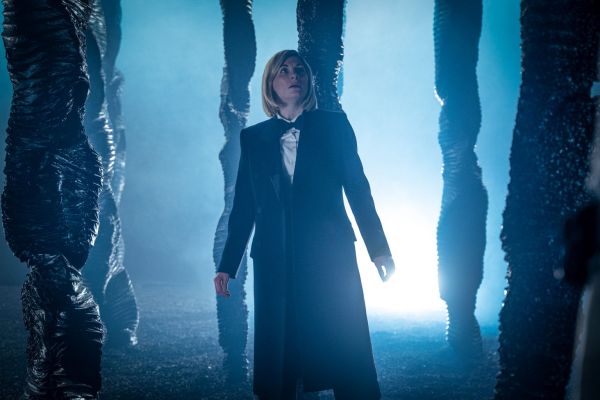 I love a good two-parter, I really do. But I’ll also admit that it’s extremely hard to stick the landing on one. The best two-parters have pretty explosive (sometimes literally) cliffhangers that have to be satisfactorily dealt with before the rest of the episode can focus on actually concluding the greater story being told. This was something previous eras of Doctor Who had struggled with a bit; RTD tended to write himself into corners that required a deus ex machina solution while Moffat’s two-parters often were more spiritually connected than narratively. Both of them frequently struggled with figuring out a way to properly conclude the stories they were telling. With Spyfall being the first two-parter from the new showrunner, Chris Chibnall, the hope would be that he’d find a good way to thread this needle. And, for the most part, he does a pretty good job, delivering an episode that’s most definitely a narrative continuation of the previous and providing some solid answers while setting up an intriguing throughline for the rest of the season. (This review will contain spoilers for Spyfall, Part 2. Proceed at your own risk.)
 Thoroughly Modern Reviewer