
 I love it when elements of Classic Who and New Who are combined to tell a whole new story. With a history this vast Doctor Who is a franchise that’s perfect for such a mashup of the old and new. Especially given how much of a mixture of old and new this current era is – what with its female Doctor and its throwback to a three-companion TARDIS team. So, when the news broke that Sophie Alfred, the actress who played Ace (companion of the 7th Doctor and the prototype for the modern Doctor Who companion as we know them), would be writing a book detailing an adventure where Ace meets the current Doctor and her companions, I was totally on board. And, I gotta tell you, it’s a really good book. In fact, it’s so good that I wish it could be adapted into an episode or two of the show itself. (Mild spoilers follow.)
Doctor Who: At Childhood’s End (by Sophie Aldred, with Steve Cole and Mike Tucker)
Once, a girl called Ace travelled the universe with the Doctor – until, in the wake of a terrible tragedy they parted company. Decades later, she is known as Dorothy McShane, the reclusive millionaire philanthropist who heads global organisation A Charitable Earth. And Dorothy is haunted by terrible nightmares, vivid dreams that begin just as scores of young runaways are vanishing from the dark alleyways of London. Could the disappearances be linked to sightings of sinister creatures lurking in the city shadows? Why has an alien satellite entered a secret orbit around the Moon?Investigating the satellite with Ryan, Graham and Yaz, the Doctor is thrown together with Ace once more. Together they must unravel a malevolent plot that will cost thousands of lives. But can the Doctor atone for her past incarnation’s behaviour – and how much must Ace sacrifice to win victory not only for herself, but for the Earth?
 Mary Shelley + The Doctor + Gothic Ghost Story = genius idea. I mean, what else could you want? It’s such a good idea that it’s genuinely surprising the show has never done something like this before. To be fair, Big Finish Productions have done some audio adventures featuring Mary Shelley teaming up with Paul McGann’s Eighth Doctor, but never has the show itself taken us on a trip to this particular part of history. And what better night for a Doctor Who story to take place on than the night Mary Shelley purportedly came up with the idea for her classic, Frankenstein. So, this would all seem like a pretty good set up for a great episode of Doctor Who. And, to be fair, it is – but not for the reasons you’d think. At the end of the day, it’s kind of a Frankenstein of an episode – pun intended – in the best possible way. (Spoilers ahead!)
  I’ve said it before and I’ll say it again: short stories are a great medium for Doctor Who tales. They provide authors with a nice ability to tell the kinds of stories that maybe wouldn’t quite work as an episode of the show and are too short to support an entire novel. Some of the most creative Doctor Who adventures have come from these collections of short stories (see the recently published Target Collection for examples) and I always look forward to them when they come out. Star Tales is no exception, especially as it finally unveils some of the stories behind the Doctor’s frequently referenced encounters with celebrities. This go ’round, we get our first collection of stories that primarily focuses on the Thirteenth Doctor and her companions – Ryan, Yaz, and Graham – save for one story, early on. How are the stories in this collection? They’re pretty good and definitely worth reading if you’re a fan of this era of the show. (Mild spoilers for the stories within Star Tales.)
 This week’s episode of Doctor Who was another one of those episodes where I had no idea what to expect before watching it. The BBC’s promotional efforts for the episode played things very close to the chest, revealing only that it would be a fairly creepy episode and the villain, Zellin (Ian Gelder), would be doing something involving dreams and nightmares. Aside from that, it was super unclear what to expect from the episode. And, frankly, I think it really worked out in this instance because Can You Hear Me? is one of those episodes that has to be seen to be truly appreciated and understood. So, did I like the episode? For sure, though I think it could have benefitted from being a two-part story. (Spoilers follow!)
  This episode was a weird one for me because, unlike last week’s, I had exactly no excitement for it. I knew there was no way the episode would actually be continuing any of the overarching plot threads introduced in Fugitive of the Judoon, and after an episode as explosive as that one, it was really hard to be excited for an episode that would just be bog-standard Doctor Who. Now, to be fair, there’s nothing wrong with regular, old stand-alone episodes of the show, but after something as exciting and groundbreaking as last week’s episode, it’s difficult to really get excited for “another random adventure!”. With that said, though, Praxeus is an excellent example of how great a stand-alone episode of Doctor Who can be. (Spoilers follow!)
  The Judoon are an interesting species but I, personally, have never understood the love for them. They’re rarely the actual antagonist of an episode, acting merely as a force for both the Doctor and the antagonist to face off against. So, while it’s cool they’re coming back in an episode more focused on them than those they’ve most recently appeared in, I can’t say that they were the big draw for me going into this episode. In fact, perhaps the most exciting thing about this episode, going into it, was the publicity hype it got beforehand. Throughout the last week, various official social media accounts tied to the BBC and Doctor Who have been teasing something that would be more shocking than the surprise reveal of the Master in the season premiere. Now that’s an exciting thing to tease before an episode airs. But, surely, they can’t actually deliver on that kind of monumental hype, can they? Short answer: YES. (This review features spoilers for Fugitive of the Judoon.)
 I love a good celebrity historical episode of Doctor Who. There’s just something that’s inherently fun about seeing the Doctor meet some famous person from history and have an adventure with them. Some of the best celebrity historicals are when Doctor Who answers some previously-unanswered question about that historical figure’s life – in The Unicorn and the Wasp, the show posits an answer to the question of why Agatha Christie went missing for a week, only to reappear with no memory of those days. So, when it was revealed that we’d be getting an episode about Nikola Tesla – who infamously claimed to have seen UFOs at one point in his life – it seemed like the show was setting us up for a really fun romp between the Doctor and Tesla that might answer the question of what, exactly, Tesla saw – which sounds really interesting. And with a title as bonkers as Nikola Tesla’s Night of Terror, it seemed as though we’d be getting an episode every bit as fun as its premise would suggest. So, was the episode interesting and fun? Was it good? Answer: yes. It is an immensely fun episode. (This review contains spoilers for Nikola Tesla’s Night of Terror.)
 Last year, the Target line of Doctor Who novelizations burst back to life with the first adaptations of episodes from the revived TV series –
  Ed Hime’s previous Doctor Who episode, It Takes You Away, was one of my favorite episodes of the previous season. I thought it had a perfect balance of character stuff and plot stuff and it was just a whole lot of fun to watch – especially with that whole bonkers idea of a sentient universe presenting itself as a talking frog. With that episode being as good as it was, I was definitely looking forward to what Hime would do in his second episode. I mean, there’s no realistic way it was gonna be quite as weird as his first, but I hoped it would be pretty fun. And, to be fair, it was very fun. Orphan 55 has a great premise, some great characters, a poignant message, and some truly scary monsters. It’s an extremely entertaining episode that’s let down a little bit by a very on the nose ending. (Spoilers follow!)
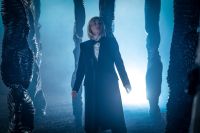 I love a good two-parter, I really do. But I’ll also admit that it’s extremely hard to stick the landing on one. The best two-parters have pretty explosive (sometimes literally) cliffhangers that have to be satisfactorily dealt with before the rest of the episode can focus on actually concluding the greater story being told. This was something previous eras of Doctor Who had struggled with a bit; RTD tended to write himself into corners that required a deus ex machina solution while Moffat’s two-parters often were more spiritually connected than narratively. Both of them frequently struggled with figuring out a way to properly conclude the stories they were telling. With Spyfall being the first two-parter from the new showrunner, Chris Chibnall, the hope would be that he’d find a good way to thread this needle. And, for the most part, he does a pretty good job, delivering an episode that’s most definitely a narrative continuation of the previous and providing some solid answers while setting up an intriguing throughline for the rest of the season. (This review will contain spoilers for Spyfall, Part 2. Proceed at your own risk.)
 Thoroughly Modern Reviewer