
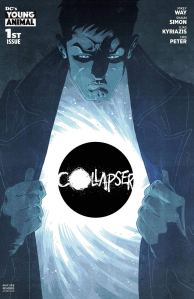
I’ve read a lot of Gerard Way’s comics in the past. The Umbrella Academy ranks among my favorite comic series. I’ve also read some of Shaun Simon’s work with Gerard, namely The True Lives of the Fabulous Killjoys. However, I’ve never encountered much of Mikey Way’s stuff outside of his work in My Chemical Romance. It’s not surprising to see him venture into comics – it’s always seemed to be something he and his brother shared in common. But when I heard about his comic, Collapser, I was really interested. The premise was intriguing and I like weird science fiction ideas. However, after reading it, I have to say that I didn’t really like this comic. And it’s a big shame because the premise sounded so interesting. A guy, Liam, ends up with a black hole inside his chest that gives him the power to alter reality as he sees fit. What’s not to like about that? The answer: the execution. (2.5 out of 5 wands.)
(NOTE: Mild spoilers follow!)
Continue readingCollapser by Shaun Simon and Mikey Way, illustrated by Ilias Kyriazis
There’s a voice in the head of Liam James questioning everything he does—from his job at the nursing home to keeping his relationship with his girlfriend afloat. Liam suffers from anxiety, and the only thing that quiets it is music, which makes a weekly DJ gig his one saving grace. But Liam’s life changes forever when he receives a black hole in the mail (yes, you read that right), one that takes up residence in his chest, grants him insane superpowers, turns him into a celebrity and draws him into a cosmic conflict beyond his wildest imagination. Where did this black hole come from? Why Liam? Is power the cure? Or will superstardom turn Liam into a black hole himself?
 I adore the musical Damn Yankees. I love it so much that it’s hilariously surprising that I had no idea it was based on a novel. The Year the Yankees Lost the Pennant, written by Douglass Wallop (who’d go onto co-write the musical’s script), is the novel Damn Yankees is based on. And it’s a novel that nobody seems to know much about these days. There’s no ebook of it available, so I had to actually obtain a hard copy of it to read. Why go to all of this trouble? Well, I really wanted to see how similar to the musical this novel was. And so, I gave it a read. And it’s definitely the same story as Damn Yankees. But how does it hold up against its more famous stage adaptation? Well, both versions of the story have their pros and their cons – it ultimately depends on what you’re looking for from the story. If you want to really explore Joe’s mindset during all of this, then The Year the Yankees Lost the Pennant is the book for you. It’s well-written, engaging, and a quick read. (Spoilers for both Damn Yankees and The Year the Yankees Lost the Pennant follow.)
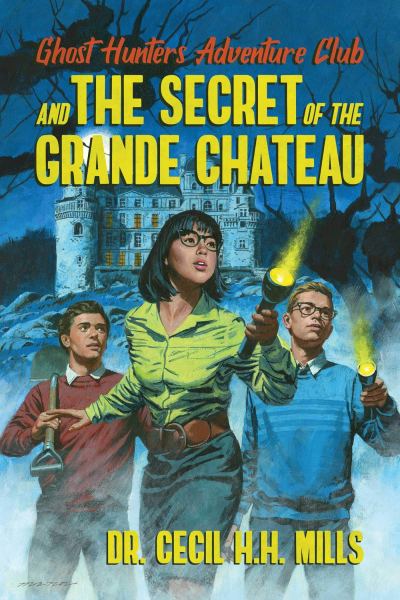 I’ve been watching the Game Grumps since 2015, or so, and I enjoy their content quite a bit. In a way, they remind me of Mystery Science Theater 3000, but instead of riffing on films, they’re riffing on video games. Arin Hanson and Dan Avidan have a great rapport together and it’s a joy to watch their videos. Why do I bring this up? Because Ghost Hunters Adventure Club and the Secret of the Grande Chateau is the “first official novel from Game Grumps.” Yes, it seems after branching into video games, the duo are branching into the literature world. So, as a fan of Game Grumps, I knew I wanted to give this book a read. But everything about its promotion felt really… strange. It seems pretty obvious that the novel is actually authored by Arin Hanson, yet it’s credited to a Cecil H.H. Mills, a man whom Arin claims is his uncle (but is obviously just Hanson in a wig and some makeup). Everything about the book’s promotion felt like one of Game Grump’s extended bits and, as a lover of books, it made it kind of difficult to get excited for this novel as I could never tell if it was something serious or just a joke. And, having now read the novel, I’m still not sure if it’s meant to be taken seriously. If it’s supposed to just be a bit of fun that satirizes Nancy Drew/Hardy Boys books and does a bit of fun character work with Cecil H.H. Mills, it’s pretty solid. But if it’s meant to be taken even a little bit seriously, it’s a really rough read. (Mild spoilers follow).)
 I have consistently loved Simon Spurrier’s run on The Dreaming. Of all the Sandman Universe titles, it’s the one that feels the most similar in tone to Neil Gaiman’s original Sandman run. Much like Gaiman, Spurrier has been using his run on the title to muse on the very nature of storytelling. His run has been as much about the art of storytelling as it has been about the Dreaming, and its inhabitants. It’s routinely been one of my favorite titles to return to and when I heard that this volume would be the final one in his run, I was a mixture of sad and excited. It would be sad to see him go, but I was excited to see how he’d wrap up this story he’s been telling since the very first issue. And here we are, at the end. And how is that ending? Well, it’s everything I could’ve hoped for. Spurrier has taken all the threads he’d left dangling and woven them into a wholly satisfying conclusion, ending this story while leaving the door wide open for future creative teams to tell new stories. It’s simply superb. (Mild spoilers follow.)
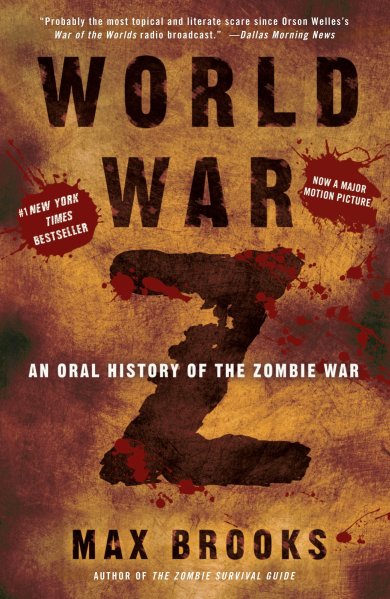 I imagine a lot of people are going to be reading zombie books during this COVID-19 crisis. Just like the Contagion film has seen a spike in popularity, so too, I feel, will many zombie stories. I can’t blame people for turning to fiction during this time of crisis; it can be cathartic to view a disaster movie in a time of disaster. But that’s not why I finally picked up World War Z. World War Z is one of those books I’ve been meaning to read for years. It’s frequently touted as one of the best zombie novels. I read an early screenplay for the film – back when it still tried to adhere to the book’s structure – and loved that, but I just never got around to reading the book. And then I heard that the novel’s author, Max Brooks, was publishing a new novel this year – Devolution – and I thought now was the time to finally give World War Z a read. At the end of the day, I totally see why World War Z is as beloved as it is. It’s a really unique take on the zombie genre, combining it with a traditional oral history of a real-world war is a stroke of genius. But I don’t know that I loved this book. It’s good, but the hype might have killed it for me. (Mild spoilers may follow.)
 I love Night Vale. A lot. It’s one of those ideas that is eternally malleable. There’s so much that can be done with these characters and the setting and novels are a really good way for the authors to push the boundaries of the world. It’s what they did with the first two novels, Welcome to Night Vale and It Devours! and it’s obviously what they’re seeking to do here with their third, The Faceless Old Woman Who Secretly Lives in Your Home. The Faceless Old Woman is the perfect character for a book devoted to her, much like the Man in the Tan Jacket was a perfect character to explore in the first novel, and the promise of finally learning her story was one that immensely interested me and got me really pumped to give this book a read. Having read it, I can safely say that it does not disappoint. For long time fans of the podcast and previous books, this one might take some getting used to, but the story it tells does complete justice to the character while still spinning a story that’s full of surprise and pathos. (Mild spoilers may follow.)
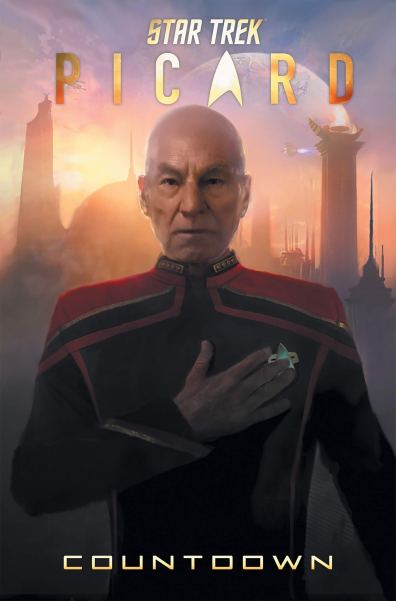 I’ve never read a piece of Star Trek fiction before. Well, unless you count that weird crossover comic with Doctor Who from 2012/2013. In fact, my only real exposure to Star Trek, in general, comes from a handful of episodes of The Next Generation, the first two JJ Abrams movies, and general cultural osmosis. But when the trailers for Star Trek: Picard started dropping, I found my interest piqued. It looked like the kind of show I’d be interested in, so I made a point of watching it. At this point, several episodes have aired and I’m really enjoying the show, so I went and looked to see if anything had been released to tie into the show. And lo, and behold, there was this three-issue prequel comic from IDW, written by Kirsten Beyer and Mike Johnson and illustrated by Angel Hernandez, that promised to reveal some of the events that happened prior to the start of the show. It sounded like the kind of thing I’d be interested in, so I picked up the issues and gave them a read and, I gotta say, it’s really solid. Though a bit short, Star Trek: Picard – Countdown tells a really good story that shines a bit of light on Picard’s history before the beginning of Star Trek: Picard. (Mild spoilers may follow.)
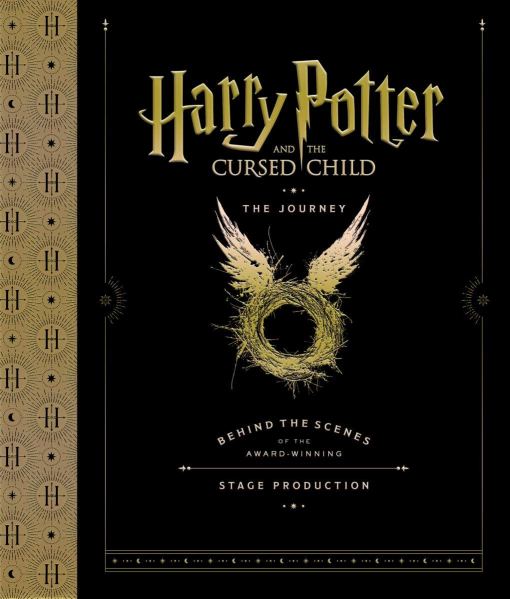 I am one of the (seemingly) few people who really liked the script for Harry Potter and the Cursed Child. It wasn’t perfect by any means, but I felt it had a lot of really interesting ideas and it explored some themes that I thought were worthwhile to explore in a Harry Potter story. But more than that, it seemed like the kind of story that could only work on stage; the kind of production that would have taken countless amounts of people and manhours to pull off. As someone who is literally in university studying theatre, the making of a play as huge as this one was always going to be of interest to me, especially as there’s little chance I’ll be able to make it to Broadway anytime soon to actually see this show staged. So, when Scholastic decided to publish this book all about how the play was created and initially staged, I jumped at the chance to read it. It’s exactly up my wheelhouse, and I have to say that the book does prove to be a really interesting and informative look at the making of this show – even if I do wish it went into a bit more depth.
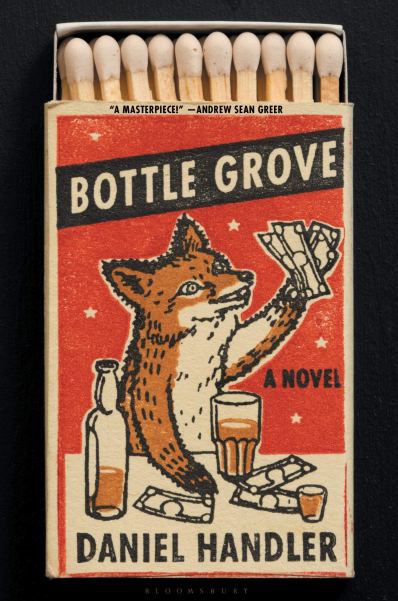 I have never read a Daniel Handler book. This is half-true. I grew up reading and loving A Series of Unfortunate Events, written by Handler under the pseudonym of Lemony Snicket. But I have never read one of Handler’s novels written for adults, under his own name. With that in mind, I really didn’t know what to expect when approaching Bottle Grove, his most recent novel. The synopsis promised something along the lines of magical realism, and I was definitely intrigued to see how Handler approached writing for adults versus writing for children – would he still have lots of fun wordplay and interesting prose? Unfortunately, I didn’t love Bottle Grove. I don’t know that I’d say it’s a bad book or anything, but it definitely wasn’t what I expect and I’m not sure it’s what I wanted, either. (Mild spoilers for the novel follow.)
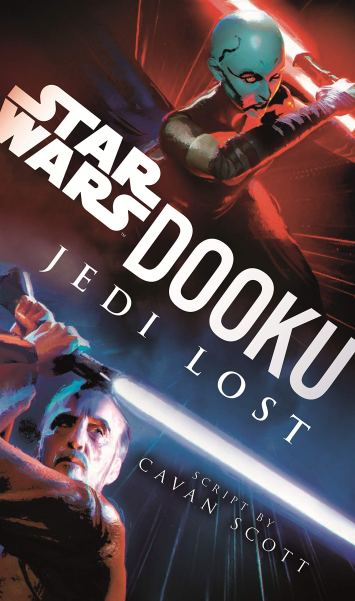 I haven’t read a single Star Wars novel since 2016’s Bloodlines (which was genuinely one of the best Star Wars stories, in general, and should be read by all Star Wars fans). It’s not that I don’t have any interest in them, although I did find it a little frustrating that so many of them were being published in the eras of the Prequel Trilogy and the Original Trilogy instead of during the era I was more interested in reading about – the Sequel Trilogy. It’s just that I didn’t really have the time to read these books that might get invalidated in a few years by another canon overhaul alongside all the other books I wanted to read. So, many Star Wars books fell by the wayside. But when I heard about Dooku: Jedi Lost, I was immediately interested. I love audio dramas and I have really enjoyed Cavan Scott’s work on various Doctor Who titles, so I was definitely intrigued. Unfortunately, having read the script and listened to the audio drama, Dooku: Jedi Lost feels more like a lost opportunity than a truly good audio drama. It’s got a good plot but the story doesn’t work well in this medium. (Spoilers follow!)
 Thoroughly Modern Reviewer