It may not be the most beloved episode of Doctor Who (or of season 7, even), but I’ve always had a soft spot for “The Angels Take Manhattan.” I love River Song and I love film noir-style detective stories. So, of course, I love an episode where River is a film noir-style detective. And in that episode, there’s a book that’s based on her adventures as this detective—Melody Malone. It’s one of my favorite elements of the episode; I mean, who doesn’t love a good book-within-a-show? Honestly, I’d love to read a novelization of the episode written like a Melody Malone novel. And, when I first came across Justin Richards’ “The Angel’s Kiss,” I thought that’s what I’d be getting—a recreation of the book featured in “The Angels Take Manhattan.” Unfortunately, that’s not what this is.
Look, I’m gonna be honest—season two of Zoey’s Extraordinary Playlist started to lose me a bit during the middle episodes. A lot of it felt like retreading familiar ground, with the show continuing to rely on the Max/Zoey/Simon love triangle (to the point where it became a love hexagon for a hot minute). But the last few episodes easily won me back, offering buckets of character development, heartfelt moments, and a whole lot of humor. And the season two finale hits a home run, managing to be everything you want a season finale to be. It satisfyingly brings many of the ongoing storylines to a close while offering a compelling pitch for a third season. As the episode ended, it felt like the show had so many different places it could go, not least of all by further exploring that jaw-dropping cliffhanger. But we’re getting ahead of ourselves. Let’s start at the very beginning. It is, after all, a very good place to start. (5 out of 5 wands.)
(NOTE: There are major spoilers for the season two finale of Zoey’s Extraordinary Playlist. Read at your own risk.)
Zoey’s Extraordinary Playlist 2×13: “Zoey’s Extraordinary Goodbye” (Written by Austin Winsberg, directed by John Terlesky) In the season finale, Zoey must face a difficult goodbye.
It’s an absolute delight to be living in a world where Christopher Eccleston is acting in new Doctor Who stories featuring his Doctor. Like Paul McGann, Eccleston’s time on the show was brief but full of promise. So, it’s quite nice to see him return to the role after a nearly sixteen-year absence in a new series of audio dramas for Big Finish. Unfortunately, the first set of these stories, Doctor Who: Ravagers, isn’t the home run it could’ve been. It’s not a bad set, or anything, just an underwhelming one. It’s a three-part story that’s stretched across two-and-a-half hours and, honestly, the story just doesn’t support its length. But still—it feels like a story that might’ve aired during the Ninth Doctor’s era. Plus, Christopher Eccleston was always going to be the selling point of these sets and he doesn’t disappoint here. (3 out of 5 wands.)
(NOTE: Minor spoilers for Doctor Who: Ravagers follow. Major plot points are not spoiled, but read at your own risk.)
“Doctor Who: Ravagers” (written by Nicholas Briggs) 1.1 Sphere of Freedom – On the Sphere of Freedom, the Doctor is about to shut down an evil Immersive Games business empire. He’s assisted by a valiant galley chef called Nova. But his plan spectacularly fails… And who exactly is Audrey?
1.2 Cataclysm – Nova is dislocated in time while the Time Eddies are out of control. Meanwhile, the Doctor is about to face the end of the universe. Or is that just the Battle of Waterloo?
1.3 Food Fight – The TARDIS is starting to get a little crowded! Audrey finds herself haunted by a ghostly Doctor.
I’m gonna be honest—the only reason I watched Girls5eva is because Sara Bareilles and Renée Elise Goldsberry were in it. I never watched Unbreakable Kimmy Schmidt and I’m not the biggest fan of Tina Fey comedies (they’re well-made but the humor tends not to be my particular cup of tea). But, I gotta say, I enjoyed Girls5eva. To be clear, based solely on its writing, it’s a pretty standard comedy. I’ve seen similar premises done in similar ways before, and the jokes are a bit hit or miss. But Girls5eva’s special sauce is its cast. Bareilles, Goldsberry, Paula Pell, and Busy Philipps are so good that they frequently pick up the writing’s slack. Plus, there’s a whole host of entertaining guest stars that join them, making Girls5eva worth watching for its outstanding cast, alone. (3 out of 5 wands.)
Girls5eva (created by Meredith Scardino) When a one-hit-wonder girl group from the 90’s gets sampled by a young rapper, its members reunite to give their pop star dreams one more shot. They may be grown women balancing spouses, kids, jobs, debt, aging parents, and shoulder pain, but can‘t they also be Girls5eva?
Most movie novelizations end up being a not-quite-final draft of the film’s script converted into prose. There’s the occasional deleted scene or expanded character backstory, but it’s mostly just a book version of the film, as you’d have seen it. Doctor Who: The TV Movie is precisely that kind of novelization. It’s well written, sure, and Russell’s prose adds a fair amount of depth to the story that a ninety-minute TV film simply can’t have. But it’s still a very safe, very standard novelization. It’s a little disappointing compared to how different some of the other recent Target novelizations are to their original stories, but I’m kind of okay with Russell’s adaptation being as faithful and safe as it is. I have quite the soft spot for the TV film, and Russell’s novel does a great job of capturing what works about the film. (4 out of 5 wands.)
NOTE: This review features mild spoilers for Doctor Who: The TV Movie and its novelization. Read at your own risk.
Doctor Who: The TV Movie (written by Gary Russell) It’s December 1999, and strange things are happening as the new millennium nears. A British police box appears from nowhere in San Francisco’s Chinatown and the mysterious man inside it is shot down in the street. Despite the best efforts of Dr Grace Holloway, the man dies and another stranger appears, claiming to be the same person in a different body: a wanderer in time and space known only as the Doctor.
But the Doctor is not the only alien in San Francisco. His deadly adversary the Master is murdering his way through the city and has taken control of the TARDIS. The Master is desperate to take the Doctor’s newly regenerated body for himself, and if the Doctor does not capitulate, it will literally cost him the Earth… and every last life on it.
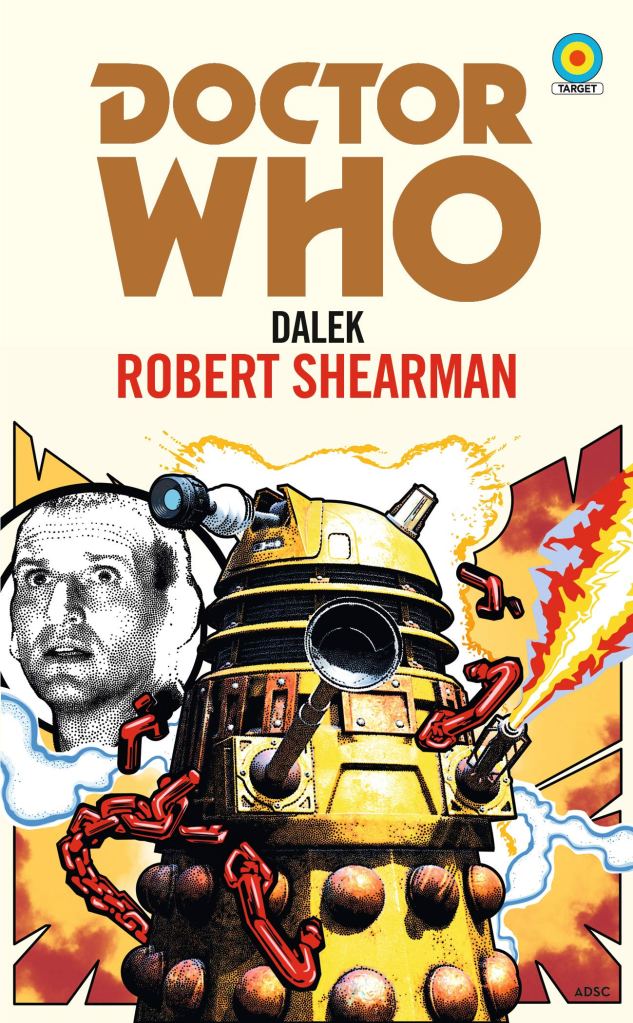
Dalek is a perfect episode of Doctor Who. It’s got great character work, thrilling action sequences, and an expertly crafted and executed plot. The idea of novelizing the episode must have been a daunting one for Robert Shearman, the episode’s original writer and the author of this new Target novelization. How do you successfully translate the episode’s bone-chilling tension into prose? The answer, in Dalek’s case, is that you don’t. Instead, Shearman takes the opportunity to delve deeper into the story, stretching out the backstories of all of the characters and allowing the narrative a lot of room to breathe. This results in a compelling novel, but one that lacks the tension and focus of the episode it’s adapting. It’s a fun read—but a wildly different experience when compared to the episode. (4 out of 5 wands.)
NOTE: There will be mild spoilers for “Dalek” ahead. Read at your own risk.
Doctor Who: Dalek (written by Robert Shearman) The Doctor and Rose arrive in an underground vault in Utah in the near future. The vault is filled with alien artefacts. Its billionaire owner, Henry van Statten, even has possession of a living alien creature, a mechanical monster in chains that he has named a Metaltron. Seeking to help the Metaltron, the Doctor is appalled to find it is in fact a Dalek – one that has survived the horrors of the Time War just as he has. And as the Dalek breaks loose, the Doctor is brought back to the brutality and desperation of his darkest hours spent fighting the creatures of Skaro… this time with the Earth as their battlefield.
If there are two things I feel are overused in current Doctor Who expanded universe material, it’s the Tenth Doctor and the Daleks. So, it’s kind of weird that I’d find myself so excited for Dalek Universe, the newest series of Tenth Doctor audio boxsets from Big Finish Productions. Truth is, I’m interested in it because it reminds me a bit of the (infamously missing) First Doctor story, “The Daleks’ Masterplan.” That story was, partially, an attempt to flesh out the Dalek universe, introducing The Space Security Service, multiple planets/governments, and a universe that’s constantly at war with the Daleks. It’s one of those Doctor Who things that has always begged for further exploration, and it’s bonkers to think that the show has never really returned to it. This is why it was so exciting to see Big Finish leaning into it as hard as they are with Dalek Universe. This first volume of Dalek Universe feels like a prelude for stories to come. It’s an exciting, sweeping space opera that reintroduces elements from Classic Who into the world of New Who. It features fantastic sci-fi ideas, David Tennant’s best Big Finish performance to date, and a captivating throughline that makes me eager to hear the rest of the series. Plus, if you’re like me and a bit tired of the Daleks, then fret not. The Daleks barely appear in this. (4.5 out of 5 wands.)
NOTE: There will be minor spoilers for Dalek Universe 1. Nothing major is spoiled, but read at your own risk.
Doctor Who: Dalek Universe 1 (written by John Dorney and Andrew Smith) Time has gone awry. The Doctor is lost, without his TARDIS. But he’s not alone. The Space Security Service agents Anya Kingdom and Mark Seven haven’t always been on his side in the past, but now they are here to help him. And he’s going to need them – because the oldest foes of all are waiting to strike. Ready to take down their greatest enemy…
The Target range of Doctor Who novelizations has long held the ability to transform an otherwise average-to-bad episode of the show into a memorable and enjoyable book. Sometimes, what doesn’t work on screen is destined to work on the page, and granting the original screenwriter the opportunity to expand upon their script often yields exciting results. This is the mindset I approached the latest wave of the range with. Neither “The Crimson Horror” nor “The Witchfinders” are bad episodes of Doctor Who, but they are decidedly average ones, which means there’s quite a lot of room for them to be bettered in a novelization. While “The Crimson Horror” doesn’t really achieve this feat, “The Witchfinders” does. And, to be fair, both novels are immensely enjoyable and should prove pleasing to any Doctor Who fan who decides to read either story.
“Doctor Who: The Crimson Horror” by Mark Gatiss Something ghastly is afoot in Victorian Yorkshire. Something that kills. Bodies are washing up in the canal, their skin a waxy, glowing red… But just what is this crimson horror? Madam Vastra, Jenny and Strax are despatched to investigate the mystery. Strangely reluctant to assist their enquiries is Mrs Winifred Gillyflower, matriarch of ‘Sweetville’, a seemingly utopian workers’ community. Why do all roads lead to the team’s old friends Clara and the Doctor? Who is Mrs Gillyflower’s mysterious silent partner Mr Sweet? And will the motley gang be in time to defeat the mysterious power that threatens all the world with its poison?
“Doctor Who: The Witchfinders” by Joy Wilkinson The TARDIS lands in the Lancashire village of Bilehurst Cragg in the 17th century, and the Doctor, Ryan, Graham and Yaz soon become embroiled in a witch trial run by the local landowner. Fear stalks the land, and the arrival of King James I only serves to intensify the witch hunt. But the Doctor soon realises there is something more sinister than paranoia and superstition at work. Tendrils of living mud stir in the ground and the dead lurch back to horrifying life as an evil alien presence begins to revive. The Doctor and her friends must save not only the people of Bilehurst Cragg from the wakening forces, but the entire world.
If you’re a sci-fi fan and you’re not watching Debris, you’re missing out on a fun show. Debris is one of those weird experiments in how little exposition a show can get away with giving. The pilot episode drops viewers in the middle of the action, with Brian and Finola having been tracking debris for several weeks already. It’s a gutsy way to start such a high-concept series, for sure. But it’s honestly a breath of fresh air in a genre that usually spends an unwieldy amount of time setting premises up before anything interesting happens. It’s nice getting right to the action, especially when the action involves a new piece of Debris each week that lets the writers explore a multitude of science fiction ideas. Want a story about clones? Check out episode two. Want something involving wormholes? Episode three’s your bet. Want to see an episode where old people can become young again? Watch episode six. I’m not always the biggest fan of procedural shows, but Debris offers a nice balance between fun cases of the week and an intriguing ongoing mystery—there’s some kind of terrorist group trying to find the pieces of debris before the various governments can and they seem to be up to no good. The mystery needs some development, but it’s enough to keep you coming back each week to see the newest strange case.
I haven’t regularly watched SVU since Christopher Meloni’s Detective Stabler left the show, so I was pretty excited to see his long-awaited return in this two-part crossover/pilot for the latest Law & Order spin-off. And, as expected, it’s a bit of a mixed bag. There’s a lot of stuff I liked and a lot of stuff I didn’t like. On the good side, it’s nice seeing Mariska Hargitay’s Olivia Benson reunited with Meloni’s Stabler. You can feel the years of chemistry they’ve got, mixed in with the years of tension caused by Stabler’s disappearance from her life. As a fan of those older episodes, there’s a certain nostalgic joy found in simply seeing the two of them interact with each other again. And I appreciated the way the show embraced the idea of Stabler’s sudden disappearance (he was unceremoniously written off the show between seasons when Meloni didn’t renew his contract) having weighed heavily on Benson. The scenes they shared, and the way the two episodes dig deep into that trauma, make the whole event worth watching.






 Thoroughly Modern Reviewer