
 Ed Hime’s previous Doctor Who episode, It Takes You Away, was one of my favorite episodes of the previous season. I thought it had a perfect balance of character stuff and plot stuff and it was just a whole lot of fun to watch – especially with that whole bonkers idea of a sentient universe presenting itself as a talking frog. With that episode being as good as it was, I was definitely looking forward to what Hime would do in his second episode. I mean, there’s no realistic way it was gonna be quite as weird as his first, but I hoped it would be pretty fun. And, to be fair, it was very fun. Orphan 55 has a great premise, some great characters, a poignant message, and some truly scary monsters. It’s an extremely entertaining episode that’s let down a little bit by a very on the nose ending. (Spoilers follow!)
Season 12, Episode 3: Orphan 55 (written by Ed Hime, directed by director Lee Haven Jones)
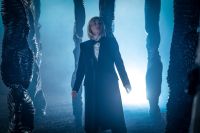
Having decided that everyone could do with a holiday, the Doctor (Jodie Whittaker) takes Graham (Bradley Walsh), Yaz (Mandip Gill), and Ryan (Tosin Cole) to a luxury resort for a spot of rest and relaxation. However, they discover the place where they are having a break is hiding a number of deadly secrets. What are the ferocious monsters that are attacking Tranquillity Spa?
 It should come as no surprise to anyone that I love a good musical. There’s something that’s just so fun about musicals. Something so heartfelt about that. I’ll also be one of the first to admit that it’s incredibly difficult to pull off a TV show that’s also a musical. Musical films are a little easier to do, but musical shows seem unable to find a way to balance all of the necessary elements in a way that’s sustainable in the long term. Glee came the closest, but its writing quickly fizzled out after a few seasons and both SMASH and RISE failed to attract a large enough audience to justify their existence. But along comes Zoey’s Extraordinary Playlist, a show that owes a lot to those previous attempts at musical tv shows. Having seen the first four episodes of its first season, it seems that Zoey’s Extraordinary Playlist might have found a way to balance all of the elements of a good musical with the necessary elements of a long-running TV show. But the question still remains if it can find an audience and/or maintain its quality writing and energy in the long term. All of that aside, these first four episodes are pretty darn good, though.
 I love a good two-parter, I really do. But I’ll also admit that it’s extremely hard to stick the landing on one. The best two-parters have pretty explosive (sometimes literally) cliffhangers that have to be satisfactorily dealt with before the rest of the episode can focus on actually concluding the greater story being told. This was something previous eras of Doctor Who had struggled with a bit; RTD tended to write himself into corners that required a deus ex machina solution while Moffat’s two-parters often were more spiritually connected than narratively. Both of them frequently struggled with figuring out a way to properly conclude the stories they were telling. With Spyfall being the first two-parter from the new showrunner, Chris Chibnall, the hope would be that he’d find a good way to thread this needle. And, for the most part, he does a pretty good job, delivering an episode that’s most definitely a narrative continuation of the previous and providing some solid answers while setting up an intriguing throughline for the rest of the season. (This review will contain spoilers for Spyfall, Part 2. Proceed at your own risk.)
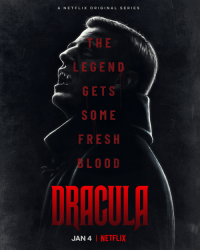 I was one of the few people who remained a fan of Moffat throughout his tenure on Doctor Who. His episodes certainly weren’t perfect, and often ranged dramatically in quality, but I was mostly on board with what he was doing with the storyline – even if his grasp on writing the companions’ character arcs was always weak. I also really enjoyed the first two seasons of Sherlock – even two of those first six episodes weren’t particularly good. While Moffat’s run on Doctor Who was mostly consistent, his and Gatiss’ work on Sherlock took a noticeable dip in quality during the third and fourth seasons, completely blowing any goodwill they’d accumulated from the fanbase by the end of the fourth season’s finale. And it’s this trend of inconsistent quality that brings us to Dracula. There is something appealing about the writers who revived Sherlock Holmes for a new generation tackling another literary legend like Dracula. In that sense, I was very excited to see what they’d do, hoping it would skew closer to the first two seasons of Sherlock in terms of quality. Unfortunately, it skewed heavily toward the last two seasons of Sherlock, giving us a mess of a show that tries to be more clever than it is and eschews telling any kind of coherent story in favor of distracting plot twists that don’t work half as well as Moffat and Gatiss think they do. (Spoilers for all three episodes of Dracula.)
 After a full year, Doctor Who has finally returned to our TV screens! While I may not have totally loved Chris Chibnall’s first season as showrunner, I did quite enjoy Jodie Whittaker as the 13th Doctor. She brought a lot of energy and commitment to the role and it was hard to dislike her as the character, even if I wish the writing of her episodes was stronger. The same was true for her friends, Ryan (Tosin Cole), Yaz (Mandip Gill), and Graham (Bradley Walsh) – all of whom brought such energy to their characters, but many of whom felt underdeveloped. Luckily, all four of these actors have returned for this sophomore outing for the 13th Doctor, and if this first episode is anything to go by, it looks like they’re in for quite the adventure. It’s always hard to judge a two-part story when you’ve only seen its first part, and that remains true for this story. That being said, Spyfall (Part 1) is certainly an excellent first half of a story, ticking every box you’d want ticked and perfectly setting up a pretty exciting second half. (Major spoilers for Spyfall, Part 1 follow!)
 One of the things I’ve most wanted from a Star Wars story was something that felt similar to Firefly. There’s just something I find endlessly fascinating about watching a group of loveable outlaws struggles against an oppressive government. That’s exactly what Firefly excelled at and it would seem that the Star Wars universe would be perfect for such a story. And for a long time, George Lucas was working on a show that explored the underworld of the Star Wars universe, but it was ultimately deemed too expensive to do in the latter half of the first decade of the 2000s and was completely shelved when Disney bought Lucasfilm. A glimpse of hope seemed to shine, though, when the first trailers for The Mandalorian hit the internet and it genuinely seemed as though The Mandalorian might be the show I was longing to see. You had the leader, Pedro Pascal’s unnamed Mandalorian, appearing to assemble some kind of crew to accomplish some kind of mission. Unfortunately, the actual show we got was less Firefly and more Saturday morning cartoon. Is this necessarily a bad thing? No, but it probably shouldn’t have been advertised as anything more than that. Regardless, there’s a lot of enjoyment to be found in The Mandalorian, even if it is often poorly paced, seemingly aimless, and occasionally frustrating to watch. (Spoilers for all eight episodes of The Mandalorian’s first season.)
 As the saying always goes, if the BBC won’t give Doctor Who a Christmas special on TV, then the comics will pick up the slack! And pick up the slack they do as writer, Jody Houser, and illustrator, Roberta Ingranata, team up once again to tell a new story with Jodie Whittaker’s Thirteenth Doctor and her friends – this time as they go against a holiday threat as scary as anything they’ve faced to date. It’s fun, it’s festive, and Houser and Ingranata continue to show the vast understanding they have for these characters.
 Watchmen is one of those properties that has proven notoriously difficult to adapt to other mediums, so it only seems fitting that it would similarly be difficult to review. Normally, I either review a TV show episode-by-episode, or I review it in chunks, or I review it after the finale ends. For Watchmen, the trick was deciding whether I’d review it three episodes at a time or whether I’d wait until the end of the season and just review the whole thing. As the third episode aired, it became clear that it was going to be impossible to judge this show until the ending was known. Like the graphic novel (written by Alan Moore and illustrated by Dave Gibbons), every episode/chapter of the story was clearly building to a climax that would either answer (most of) the questions posed by the story or would completely drop the ball, and the quality of the story would largely be determined by how well it executed its ending (even if individual “chapters” were excellent – episode 6 of the show and the chapter of the comic detailing Manhattan’s past). And, let’s be clear, every episode of the series was extremely good. There was a point to every episode, and they followed a very similar pattern to that of the comic (one episode would be devoted to furthering the plot along, the next would be devoted to exploring one of the key characters’ backgrounds (thus moving the emotional arcs forward) and they’d alternate back and forth like this until the climax. But with this style, it is very important that the landing pay off all of this development in a meaningful and satisfying way. Luckily, that’s exactly what the show managed to do. (Spoilers for all nine episodes of Watchmen follow. You have been warned.)
 I am on the record, repeatedly, as being a huge fan of NBC’s The Good Place. It’s not only my favorite comedy currently airing on TV but one of my favorite TV shows in general. While I felt that the middle of season three was a bit of a misstep, the show had fully pulled me back into the fold by the end of that season. So, with the news that this fourth season of The Good Place will also be its final one, these first few episodes of the show had a lot to prove. They needed to continue to be stellar episodes of television while also laying the groundwork for what will ultimately become the show’s endgame. Do they pull this off? Absolutely. (NOTE: This review will contain spoilers for the first two episodes of the season, A Girl From Arizona, Parts 1 and 2, but will remain as spoiler-free as possible for the unaired episodes that NBC has granted critics access to – episodes 3 and 4: Chillaxing and Tinker, Tailor, Demon, Spy.)
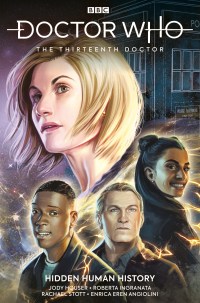 With Jodie Whittaker’s second season as the 13th Doctor delayed until 2020, fans of Doctor Who are left to turn to other mediums to get their fix of new Doctor Who stories. Thankfully, Titan Comics continues to put out new 13th Doctor comics each and every month. And they’re really good, too, with each arc comprising a single storyline that feels like a complete episode of the series!
 Thoroughly Modern Reviewer