
 Back in the 1970s, ’80s, and ’90s, nearly every serial from the classic run of Doctor Who was novelized in one way or another through a range of books published by Target Books. That practice was discontinued when the show returned in 2005, mainly due to how readily available various home video formats were. It’s a shame because many of those classic novelizations ended up being better than the televised versions (mainly because a novel doesn’t have the budget constraints of a science fiction show made on a shoestring budget in the mid-1970s). Then, just a few months ago, BBC Books decided to revive the range for a brief five-book run. Like the old range, they brought back the writers of some of the episodes while mixing it adaptations from other writers. The books adapted for this new range were Rose by Russell T. Davies (the writer of the episode), The Christmas Invasion by Jenny T. Colgan (based on a script by Russell T. Davies), The Day of the Doctor by Steven Moffat (the writer of the episode), and Twice Upon a Time by Paul Cornell (based on a script by Steven Moffat). This review, however, will be focusing on the latter two books: The Day of the Doctor and Twice Upon a Time.
Doctor Who: Day of the Doctor (by Steven Moffat): When the entire universe is at stake, three different Doctors will unite to save it. The Tenth Doctor is hunting shape-shifting Zygons in Elizabethan England. The Eleventh is investigating a rift in space-time in the present day. And one other – the man they used to be but never speak of – is fighting the Daleks in the darkest days of the Time War. Driven by demons and despair, this battle-scarred Doctor is set to take a devastating decision that will threaten the survival of the entire universe… a decision that not even a Time Lord can take alone. On this day, the Doctor’s different incarnations will come together to save the Earth… to save the universe… and to save his soul.
Doctor Who: Twice Upon a Time (by Paul Cornell): Still reeling from his encounter with the Cybermen, the First Doctor stumbles through the bitter Antarctic wind, resisting the approaching regeneration with all his strength. But as he fights his way through the snowdrifts, he comes across the familiar shape of a blue police box, and a mysterious figure who introduces himself as the Doctor… Thrown together at their most vulnerable moments, the two Doctors must discover why the snowflakes are suspended in the sky, why a First World War Captain has been lifted from his time stream moments before his death, and who is the mysterious Glass Woman who knows their true name. The Doctor is reunited with Bill, but is she all she seems? And can he hold out against the coming regeneration?
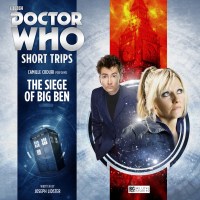 I rarely listen to the Big Finish Productions audios that only feature one voice actor because I tend to prefer the full cast format to the singular narrator format, but The Siege of Big Ben was well worth listening to. Written by Joseph Lidster, Doctor Who: The Siege of Big Ben is the latest installment of Big Finish Production’s monthly Short Trips series, a series of audios featuring a short story related to one of the Doctors Big Finish has the rights to and read by one of the original cast members from the TV series. This story featured Camille Coduri as Jackie Tyler in a story featuring the Meta-Crisis Doctor in the parallel Earth seen at the end of Journey’s End. “Jackie Tyler has everything she’s ever wanted: a loving husband and, two children. But a terrible, far-reaching plan is underway, and only Jackie and a single friend stand in the way of it. But the Doctor isn’t the man he was…”
  Shada. The long lost adventure from famed sci-fi writer Douglas Adams. Over the years since its aborted filming, the adventure has undergone no less than three separate adaptations. The question is: which Shada is the ultimate Shada? With the release of another version of the story, it’s becoming harder and harder to figure that out, so let’s break it down in a Tale of Three ‘Shada’s. Originally written by famed author – and one-time Doctor Who script editor – Douglas Adams, Shada follows the Doctor and Romana, his Time Lady companion, as they investigate a mysterious summons from an old friend of the Doctor, Cambridge Professor Chronotis, and work to thwart the plans of the evil Skagra – a man seeking the Professor, and a book he possesses, for his own evil ends. Their adventure will take them from 1970s Earth to a mysterious Time Lord prison planet that nobody can remember: Shada. Beware Skagra. Beware the Sphere. Beware Shada. For this review, we’re gonna be looking at three particular adaptations of Shada: the 2003 BBC-i/Big Finish Productions webcast/audio adaptation, the 2012 novelization (by Gareth Roberts), and the 2017 BBC animated reconstruction.
  As must always happen, another Doctor’s time has come to a close. This time we must say goodbye to Peter Capaldi, the Twelfth Doctor. Not only is this Capaldi’s swan song, but it’s also showrunner Steven Moffat’s final episode. For Doctor Who fans, the regeneration episode is always a bag of mixed emotions. It’s sad to see a beloved Doctor leave, but it’s exciting to get a glimpse of the new one and all the surprises that await us in the episodes ahead. In Twice Upon a Time (written by Steven Moffat and directed by Rachel Talalay), the Twelfth Doctor (Peter Capaldi) teams up with his former self, the First Doctor (David Bradley) and a returning Bill Potts (Pearl Mackie), for one last adventure. Two Doctors stranded in an Arctic snowscape, refusing to face regeneration. Enchanted glass people, stealing their victims from frozen time. And a World War One captain destined to die on the battlefield, but taken from the trenches to play his part in the Doctor s story. An uplifting new tale about the power of hope in humanity s darkest hours, Twice Upon A Time marks the end of an era. But as the Doctor must face his past to decide his future, his journey is only just beginning… The 60-minute special guest stars Mark Gatiss as The Captain and Nikki Amuka-Bird as the voice of the glass woman, and will see Peter Capaldi’s Doctor regenerate into the Thirteenth Doctor (Jodie Whittaker). (Mild spoilers ahead)
  I’m only a month late in talking about this, but what’s a month or two between friends? Two books, a BBC Two documentary, and an entire museum exhibit. These are the latest developments in the Harry Potter universe (as of October 2017) as the British Library launches its look into the real-life history of magic and how it intercepts J.K. Rowling’s Wizarding World. As a fan of both the Wizarding World and really great museum exhibits, I have to say that this excited me. I haven’t been able to go to the actual museum exhibit (as it’s in London and I am not), but I have read the official book of the exhibit: Harry Potter: A History of Magic and see the accompanying BBC Two Documentary. And it’s fab. Harry Potter: A History of Magic explores the intersection of history and fantasy. It’s common knowledge that much of J.K. Rowling’s world-building in the Wizarding World series originates from real history and myth, but just how much of it was real? Harry Potter: A History of Magic seeks to answer that question, and answer it, it does – with lots of panache.
 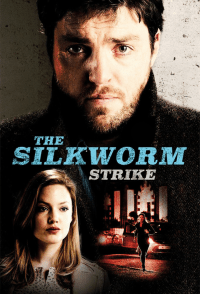 The Silkworm is stronger than The Cuckoo’s Calling in nearly every way. This is the case for the book and it’s the case for BBC’s TV adaptation, as well. Based on the novel by Robert Galbraith (a pseudonym for J.K. Rowling), The Silkworm continues the story of Cormoran Strike (Tom Burke) and his assistant, Robin Ellacott (Holliday Grainger) a number of months after the end of The Cuckoo’s Calling. Adapted by Tom Edge and directed by Kieron Hawkes, The Silkworm follows Cormoran and Robin as they investigate the mysterious disappearance of Owen Quine (Jeremy Swift) at the behest of his wife, Leonora (Monica Dolan). Owen is a provocative and somewhat famous author known for writing odd and often vulgar novels. At the time of his disappearance, Owen has just sent off the manuscript for his latest novel, Bombyx Mori, which features a “thinly veiled” slandering of many people he knows. When his body turns up dead and mutilated in exactly the same way the protagonist of Bombyx Mori’s protagonist’s death scene, the race is on to find out who, out of all those who have read Bombyx Mori, could have killed Owen Quine. (Mild Spoilers ahead)
  Like the novel it’s based on, BBC’s adaptation of The Cuckoo’s Calling isn’t anything revolutionary, but it sure is a lot of fun. Strike: The Cuckoo’s Calling is the first installment of BBC’s series of adaptations of Robert Galbraith’s (a pseudonym for J.K. Rowling) Cormoran Strike novels. Written by Ben Richards and directed by Michael Keillor, The Cuckoo’s Calling tells the story of Cormoran Strike (Tom Burke) and Robin Ellacott’s (Holliday Grainger) investigation into the death of Lula Landry (Elarica Johnson). After losing his leg to a land mine in Afghanistan, Cormoran Strike is barely scraping by as a private investigator. Comormoran Strike is down to one client, and creditors are calling. He has also just broken up with his longtime girlfriend and is living in his office. Then John Bristow (Leo Bill) walks through his door with an amazing story: His sister, the legendary supermodel Lula Landry, known to her friends as the Cuckoo, famously fell to her death a few months earlier. The police ruled it a suicide, but John refuses to believe that. The case plunges Strike into the world of multimillionaire beauties, rock-star boyfriends, and desperate designers, and it introduces him to every variety of pleasure, enticement, seduction, and delusion known to man. (As always, spoilers follow)
  It was only a matter of time before Big Finish was able to start making audios with David Tennant, and it’s exciting that they’ve finally started! Thankfully, the audios are also good! A bit uneven, but still good. It’s also worth noting that all of the stories in this box set are stand alone. There is no plotline that spans the entire set, which disappoints me a bit as I prefer my box sets to be part of one large story, but I appreciate that it allows the set to be accessible to any and everyone. But I digress. In this set, written by Matt Fitton, Jenny T Colgan, James Goss and directed by Nicholas Briggs, the Tenth Doctor (David Tennant) and Donna Noble (Catherine Tate) continue their journey through time and space together in three stand alone stories. From technology fearing people to illegal weapons to Death itself, the Doctor and Donna must unravel the mysteries that always seem to plague them whenever and wherever they go. (Spoilers ahead)
  I feel like I liked the premise of this box set more than I liked the box set itself. But, that’s not to say Doom Coalition 4 wasn’t good – because it was – it just wasn’t quite as good as I’d have liked. Written by Matt Fitton and John Dorney and directed by Ken Bentley, Doom Coalition 4 picks up exactly where Doom Coalition 3 ended: Padrac (Robert Bathurst) has trapped the Doctor (Paul McGann), Liv Chenka (Nicola Walker), and Helen Sinclair (Hattie Morahan) inside a time escape pod and launched them into the future of the destroyed universe. Meanwhile, Padrac still has River Song (Alex Kingston) in his sights, yet she seems to be on his side. Just what game is she playing and how will it play out? Will the Doctor be able to escape and thwart Padrac’s ultimate plan to destroy the universe in order to save Gallifrey? And what about the Eleven (Mark Bonnar) and Caleera (Emma Cunniffe)? Whose side are they really on and how far will they go to achieve their goals. (Spoilers ahead)
  Finally! This is the kind of box set I’ve been wanting from this series the whole time! The stories are all interconnected, especially the latter three. and on top of that, they’re all superb stories, too! Written by Matt Fitton and John Dorney and directed by Ken Bentley, Doom Coalition 3 picks up shortly after the events of the previous box set with the Doctor (Paul McGann), Liv Chenka (Nicola Walker), and Helen Sinclair (Hattie Morahan) continuing to travel throughout space and time. Naturally, wherever the Doctor goes, trouble always follows, and this is no exception as the Doctor uncovers mysterious pieces of a clock rumored to be the Doomsday Chronometer, a clock built by a Time Lord known only as The Clocksmith (Nicholas Woodeson). Can the Doctor stop the Clocksmith from bringing about the end of the universe? And how does that mysterious nun (Alex Kingston as River Song) factor into things? (Spoilers ahead.)
 Thoroughly Modern Reviewer