
 As if enough things haven’t been written about this movie, here comes another one. Ever since the announcement of this movie, I’ve been skeptical. The Joker is a character who has, historically, never had a definitive origin story – nor has he ever needed one. The entire point (and fun) of the character is that he has no origin. Various stories have hinted at one (The Killing Joke, The Dark Knight) but all have shied away from suggesting any of those origins is the definitive one. So, this movie being entirely about how the Joker became the Joker worried me a bit, though that worry was squashed a bit when they made it clear this movie wouldn’t tie into the larger DCEU and would be the cinematic equivalent of one of DC’s Elseworlds stories. With that context, it was a bit easier to get on board with a film like this. Then came all of the controversy surrounding the film – the articles about how it was irresponsible, the security concerns, etc – and the whole thing began to get a little messy. It was difficult to know what the film was actually saying versus what people were accusing the film of saying. The big question, now that opening weekend has come and gone without much incident, is whether Joker is a good movie that gets across all that it is trying to say. The answer? Yes, mostly. (NOTE: This review will contain some light spoilers for the movie, but this is one of those films where you pretty much already know how it ends; it’s not filled with surprises, but the enjoyment comes from the journey it takes you on.)
Joker (written by Scott Silver and Todd Phillips; directed by Todd Phillips)
“Joker” centers around the iconic arch nemesis and is an original, standalone fictional story not seen before on the big screen. Phillips’ exploration of Arthur Fleck, who is indelibly portrayed by Joaquin Phoenix, is of a man struggling to find his way in Gotham’s fractured society. A clown-for-hire by day, he aspires to be a stand-up comic at night…but finds the joke always seems to be on him. Caught in a cyclical existence between apathy and cruelty, Arthur makes one bad decision that brings about a chain reaction of escalating events in this gritty character study.
 I never read Neil Gaiman’s original 4-issue run of Books of Magic, nor did I read any of the subsequent runs, so, naturally, of the four titles initially announced for the first wave of Sandman Universe series, this one was the one I was least interested in. It’s not that I wasn’t interested in the premise – I love a good story about people learning how to do magic – but it was more the idea that, due to my lack of knowledge of any of the previous stories, I’d be totally lost going into this comic and find myself unable to enjoy it for what it is. Thankfully, that’s not what happened. Unfortunately, it is still my least favorite ‘volume 1’ of the three in the Sandman Universe that I’ve read so far. (Mild spoilers follow!)
 One of the most appealing parts of Neil Gaiman’s Sandman series was that it was one of those rare long-running comic books that had a definitive end. It ran for a total of 75 issues and, for a while, that was it. Over the years, Gaiman had returned a few times to the universe in order to pen a short spin-off here or a short prequel comic there, but there had never really been anything major that expanded on the world of The Sandman – aside from Mike Carey’s equally long-running Lucifer series, spun off from the character’s few appearances in the main Sandman run. So, when it was announced that Gaiman would be teaming up with Vertigo to launch The Sandman Universe, a collection of four series inspired by and expanding upon the original Sandman run, I was a bit skeptical. Of the four titles that were revealed, there were two that interested me the most: Simon Spurrier’s The Dreaming and Dan Watters’ Lucifer. As The Dreaming was the first of the four books to launch, it’ll be the first of the four that I’ll cover here. In volume one of The Dreaming, Spurrier takes us back into the realm of the Dreaming where Daniel, the current Lord of Dreams, has disappeared just as things are going wrong. And it only gets crazier from there.
 I’m not afraid to admit that Aquaman was one of my least anticipated films of 2018. It’s a movie about a character I’ve never been interested who was also deeply uninteresting in his previous big-screen appearance in last year’s Justice League. None of the trailers released for the film ever looked particularly good. The visuals were incredible, but the acting from Jason Mamoa (Aquaman) and Amber Heard (Mera) was wooden and boring to watch. So, to say I wasn’t excited about the film would be an understatement, but I love DC and I want the DC movies to succeed and to be good, so, I still saw the movie. And, to be honest, my initial impression was correct. For as innovative as the visuals were, the storytelling and acting were not. (Mild spoilers may follow)
  It’s been a while since I’ve seen such a remarkably well made Batman film. It’s even more impressive that said amazing film is a straight-to-DVD animated adaptation of a short Elseworlds graphic novel – a series of graphic novels from DC Comics that takes popular characters and places them in new situations/settings/etc. Batman: Gotham By Gaslight is an adaptation of the graphic novel of the same name, originally written by Brian Augustyn and featuring art from Mike Mignola, placing Bruce Wayne/Batman squarely in the late 1800s in Gotham City, where it seems that the infamous Jack the Ripper has relocated to continue his spree of terror by murdering women. Written by James Krieg and directed by Sam Liu, Batman: Gotham by Gaslight follows the Caped Crusader as he works – from the shadows – to stop Jack the Ripper’s reign of terror before it can get any worse while dodging the ever-suspicious Gotham police. If ever there were a crime from the world’s greatest detective, this would be it. (Mild spoilers follow.)
 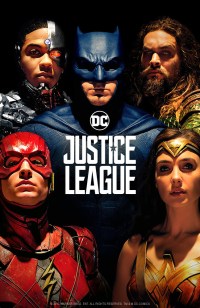 Man, I desperately wanted to like this. I will go to my grave defending Batman v Superman (particularly the Ultimate Edition, where the story actually made sense), but Justice League is, unfortunately, a bit of a mess. A fairly enjoyable – at times – mess, but a mess, nonetheless, and I’m not sure whose fault it is. Directed by Zack Snyder (with substantial reshoots and editing supervised by Joss Whedon) and written by Chris Terrio and Joss Whedon, Justice League is the DCEU’s equivalent of 2012’s The Avengers (also directed by Whedon). It brings the mightiest DC superheroes – Batman (Ben Affleck), Wonder Woman (Gal Gadot), The Flash (Ezra Miller), Aquaman (Jason Momoa), Cyborg (Ray Fisher), and Superman (Henry Cavill) – together for the first time as they team up to defend the earth from an intergalactic – and multi-dimensional? – threat: Steppenwolf (Ciarán Hinds). (Mild spoilers ahead)
  Better late than never, I suppose. I meant to review the first volume of Jody Houser’s Mother Panic back when it came out a few weeks ago, but life gets in the way sometimes. So here we go. Mother Panic is one of the several new comics from the Young Animal line from DC, headed by Gerard Way.
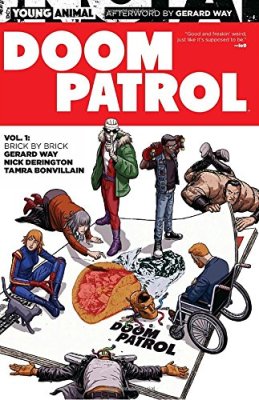 It’s been quite some time since Gerad Way has published any kind of ongoing comic series. The last one he did was The True Lives of the Fabulous Killjoys, co-written with Shaun Simon, and that was back in 2013. So, the world of comics was in need of his return. He’d been teasing the third volume of The Umbrella Academy for years now, and it was beginning to look like we’d never see another ongoing series from him again. Then came DC’s announcement of the Young Animal imprint, spearheaded by Way himself. Along with the imprint would be his first ongoing series in ages, a reboot of Doom Patrol. The big question is: was his return to comics worth the wait? Answer: yes. In volume 1 of Doom Patrol, Way reintroduces readers to the unconventional team of heroes through the lens of Casey Brinke, an EMS driver who is drawn into a series of weird circumstances when she finds the broken body of Robotman. Casey and the other members of the team must outwit a bunch of aliens who want control of a magic, sentient van that can create life. So, basically, it’s a pretty typical subject matter for a Gerard Way comic.
  If this is what it’s like to be a Greek goddess, sign me up. This movie has it all! Interesting mythology, great characters, amazing fight sequences, a well thought out plot, and an atmosphere that just makes you feel good. It’s exactly the kind of superhero movie that’s both wanted and needed right now. The latest film in the DCEU has finally come out! Directed by Patty Jenkins with a screenplay by Allan Heinberg (from a story by Heinberg, Zack Snyder, and Jason Fuchs), Wonder Woman stars Gal Gadot as the titular Amazon warrior as she makes her way through a war-torn Europe during the first World War. With the aid of Steve Trevor (a US Military Pilot who washed onto the shores of Themyscira, played by Chris Pine), Diana Prince (as she’s referred to in the movie – they never actually call her Wonder Woman) sets out to bring an end to the war before any more atrocities can be committed. But, it’s never as simple as that, is it? (This review strives to be spoiler-free, but for anybody really averse to spoilers, you might wanna wait to read this until after you’ve seen the movie. I’m not gonna go into too many specifics, especially about the latter half of the film, but regardless, this is your warning.)
 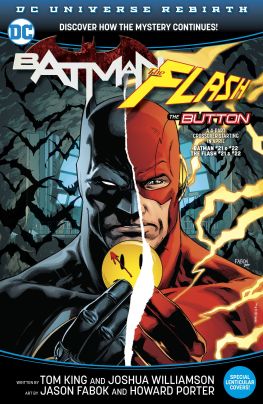 Over the past month, DC Comics has been publishing a crossover between Tom King’s Batman run and Joshua Williamson’s The Flash entitled The Button. This crossover picks up from where the DC Rebirth One-Shot left off, with Batman and the Flash discovering the Comedian’s (from Alan Moore’s Watchmen) smiley-face button stuck in the wall of the Batcave. The crossover follows Batman and the Flash as they try to track down the source of the radiation being emitted by the button while facing off against a series of personal and emotional obstacles thrown their way, seemingly on purpose.
 Thoroughly Modern Reviewer