
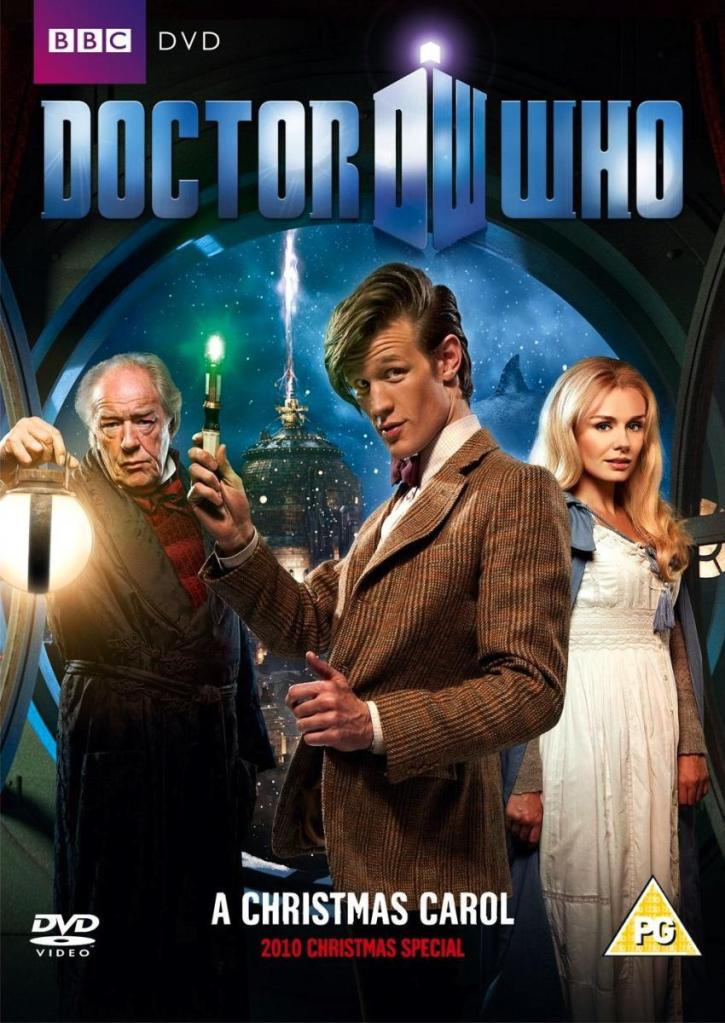
For over a decade, the whole family could gather around the TV on Christmas Day and watch a new Doctor Who Christmas special. These episodes were rarely as all-around well-executed as the series’ best episodes, but they were always packed with holiday spirit and undeniably fun to watch. No Christmas special exhibited these qualities more than the 2010 special, A Christmas Carol. Being both Steven Moffat and Matt Smith’s first Doctor Who Christmas special, it had quite a lot to live up to—and boy did it. I’d argue that A Christmas Carol is not only a great Doctor Who Christmas special but also a great episode of Doctor Who in general. Loosely adapting Charles Dickens’ classic book, A Christmas Carol, the special is jam-packed with Christmas spirit, spectacular performances, and a suitably timey-wimey plotline perfect for the 11th Doctor. It is easily my favorite Doctor Who Christmas special. (5 out of 5 wands.)
Continue readingDoctor Who: A Christmas Carol (written by Steven Moffat, directed by Toby Haynes)
Amy (Karen Gillan) and Rory (Arthur Darvill) are trapped on a crashing space liner, and the only way the Doctor (Matt Smith) can rescue them is to save the soul of a lonely old miser, Kazran Sardick (Michael Gambon, Laurence Belcher, Danny Horn). But is Sardick, the richest man in Sardicktown, beyond redemption? And what is lurking in the fogs of Christmas Eve?


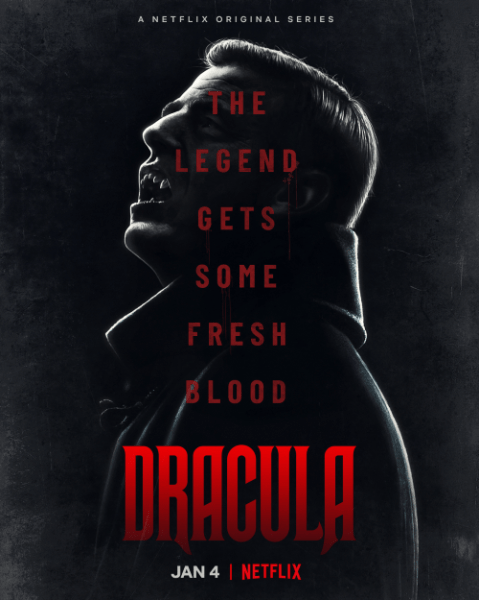 I was one of the few people who remained a fan of Moffat throughout his tenure on Doctor Who. His episodes certainly weren’t perfect, and often ranged dramatically in quality, but I was mostly on board with what he was doing with the storyline – even if his grasp on writing the companions’ character arcs was always weak. I also really enjoyed the first two seasons of Sherlock – even two of those first six episodes weren’t particularly good. While Moffat’s run on Doctor Who was mostly consistent, his and Gatiss’ work on Sherlock took a noticeable dip in quality during the third and fourth seasons, completely blowing any goodwill they’d accumulated from the fanbase by the end of the fourth season’s finale. And it’s this trend of inconsistent quality that brings us to Dracula. There is something appealing about the writers who revived Sherlock Holmes for a new generation tackling another literary legend like Dracula. In that sense, I was very excited to see what they’d do, hoping it would skew closer to the first two seasons of Sherlock in terms of quality. Unfortunately, it skewed heavily toward the last two seasons of Sherlock, giving us a mess of a show that tries to be more clever than it is and eschews telling any kind of coherent story in favor of distracting plot twists that don’t work half as well as Moffat and Gatiss think they do. (Spoilers for all three episodes of Dracula.)
 As must always happen, another Doctor’s time has come to a close. This time we must say goodbye to Peter Capaldi, the Twelfth Doctor. Not only is this Capaldi’s swan song, but it’s also showrunner Steven Moffat’s final episode. For Doctor Who fans, the regeneration episode is always a bag of mixed emotions. It’s sad to see a beloved Doctor leave, but it’s exciting to get a glimpse of the new one and all the surprises that await us in the episodes ahead. In Twice Upon a Time (written by Steven Moffat and directed by Rachel Talalay), the Twelfth Doctor (Peter Capaldi) teams up with his former self, the First Doctor (David Bradley) and a returning Bill Potts (Pearl Mackie), for one last adventure. Two Doctors stranded in an Arctic snowscape, refusing to face regeneration. Enchanted glass people, stealing their victims from frozen time. And a World War One captain destined to die on the battlefield, but taken from the trenches to play his part in the Doctor s story. An uplifting new tale about the power of hope in humanity s darkest hours, Twice Upon A Time marks the end of an era. But as the Doctor must face his past to decide his future, his journey is only just beginning… The 60-minute special guest stars Mark Gatiss as The Captain and Nikki Amuka-Bird as the voice of the glass woman, and will see Peter Capaldi’s Doctor regenerate into the Thirteenth Doctor (Jodie Whittaker). (Mild spoilers ahead)
  Better late than never, I guess. So, series 10 of Doctor Who has come to an end, and boy, what an ending it was. There were Cybermen, explosions, black holes, spaceships, two Masters, and the beginning of the end of Peter Capaldi’s Twelfth Doctor. It’s one hell of a two-part finale and the perfect icing on the cake that was this past series of the show. Written by Steven Moffat and directed by Rachel Talalay, World Enough and Time/The Doctor Falls follows the Doctor (Peter Capaldi), Bill (Pearl Mackie), and Nardole (Matt Lucas) as they arrive on a 400 mile long spaceship heading towards/away from a black hole (it’s sorta confusing). They’ve answered a distress signal the ship sent out and the Doctor has decided that this would be a great time for Missy (Michelle Gomez) to prove that she really has changed. Naturally, things don’t go according to plan at all. (There will be spoilers ahead, so if you haven’t seen the two episodes, now is your chance to turn back. Also worth noting, this review is kind of all over the place. There’s a lot of elements to try and cover, so I’ll be jumping around quite a bit.)
 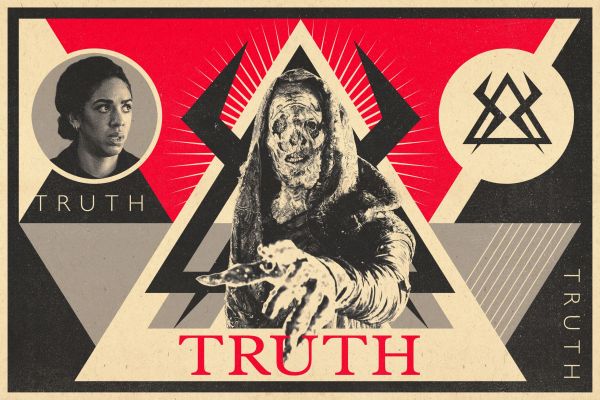 Is the idea that love will eventually overcome everything cheesy and oftentimes overdone? Yes. But, if done well, it can still be both moving and satisfying. This final part of the “Monk Trilogy” manages to get it right. Written by Toby Whithouse and directed by Wayne Yip, The Lie of the Land concludes the “Monk Trilogy” that was begun with Extremis. In this closing chapter, Earth has been invaded and Bill is living alone, an isolated figure surviving in occupied Britain. The Doctor (Peter Capaldi) is imprisoned and appears to be on the side of the enemy, flooding the airwaves with fake news. Bill(Pearl Mackie) and Nardole (Matt Lucas) must embark on a deadly mission to rescue the Doctor and lead the resistance against the new regime, whatever the cost. (As always, this review will not be spoiler free, so spoilers are ahead!)
  Who ever said a little bit of setup in a story was a bad thing? Sometimes the second part of a trilogy has to primarily act as a setup for the third part, but that doesn’t mean said second part can’t also stand on its own as a story. All the best middle parts of trilogies do that. The one that comes to mind, naturally, is The Empire Strikes Back. It very much is a setup for Return of the Jedi, but it’s frequently considered the best of the Star Wars films. Why? Because it also tells its own story. The Pyramid at the End of the World does the same thing. Being the middle part of the Monk Trilogy, The Pyramid at the End of the World acts as a setup for the final part, The Lie of the Land, while also succeeding in telling a story with character moments, stakes, and consequences. Written by Peter Harness and Steven Moffat and directed by Daniel Nettheim, The Pyramid at the End of the World follows the Doctor (Peter Capaldi) and Bill (Pearl Mackie) as they investigate a mysterious 5,000-year-old pyramid that has just appeared overnight in Turmezistan, the strategic military point that the three biggest armies of the Earth are positioned at. Inside the pyramid are the Monks, the race of beings from Extremis who plan to take over the Earth. The Monks say that humanity is about to destroy itself, and only they (the Monks) can save us. But consent must be given. Will the human race consent? (Spoilers ahead!)
 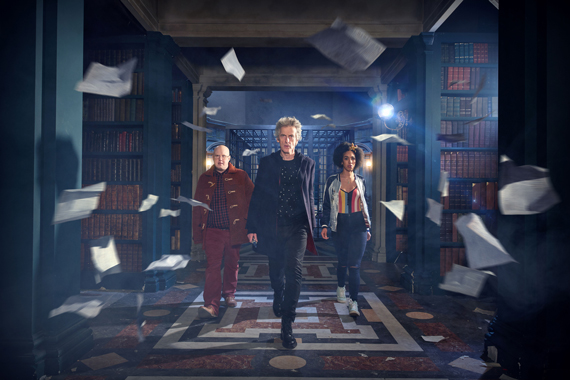 Another week, another episode of Doctor Who, another review. This week’s episode, Extremis – written by Steven Moffat and directed by Daniel Nettheim -, was the first episode of this season that I was really looking forward to. I mean, I was excited about the other episodes, don’t get me wrong, but I was most excited about this one. Especially after the teaser in this month’s Doctor Who Magazine that revealed that this would be the episode where we discovered what was inside the Vault. I love arc-heavy Doctor Who and I love when the show does different things, especially when it explores religious aspects. I’m always fond of science fiction exploring religion. And the central premise of Extremis was awful religious-sounding: ‘The Veritas. The truth. Truth so true you can’t live with it. Is that looking into hell… or seeing the light?’ Everyone who has ever read the Veritas has been found dead. In a forbidden library at the heart of the Vatican, the pope urges the Doctor to read the ancient text – but can he handle the truth? As always, this review will not be spoiler free, so stop reading now if you haven’t seen the episode! Plus, due to the nature of this episode, this review will also be somewhat of a recap as it’s impossible to talk about this episode without going into the specifics of the plot. So, seriously, don’t read this until you’ve seen the episode.
  Thoroughly Modern Reviewer