

Anyone who knows me knows that I went through a pretty hardcore Hamilton phase when that musical first hit Broadway. I played the album all the time, I knew the vast majority of the lyrics. I adored that show. And I still do, even if I think In the Heights is Lin-Manuel Miranda’s superior show. So, naturally, when the news broke that Disney+ would be debuting the live capture of the show, recorded just before the original cast departed, over a year earlier than expected, I was devilishly excited. I’d only seen bits and pieces of the show, having never had a chance to see it in person, and I was so ready to finally see this show that I loved. Well, now that I’ve seen the film, how do I feel? I mean, it’s Hamilton and I love Hamilton. But, to be honest, this capture is a bit of a mixed bag. (4 out of 5 wands.)
Continue readingHamilton (directed by Thomas Kail, written and composed by Lin-Manuel Miranda)
An unforgettable cinematic stage performance, the filmed version of the original Broadway production of “Hamilton” combines the best elements of live theater, film and streaming to bring the cultural phenomenon to homes around the world for a thrilling, once-in-a-lifetime experience. “Hamilton” is the story of America then, told by America now. Featuring a score that blends hip-hop, jazz, R&B and Broadway, “Hamilton” has taken the story of American founding father Alexander Hamilton and created a revolutionary moment in theatre—a musical that has had a profound impact on culture, politics, and education. Filmed at The Richard Rodgers Theatre on Broadway in June of 2016, the film transports its audience into the world of the Broadway show in a uniquely intimate way.


 I adore the musical Damn Yankees. I love it so much that it’s hilariously surprising that I had no idea it was based on a novel. The Year the Yankees Lost the Pennant, written by Douglass Wallop (who’d go onto co-write the musical’s script), is the novel Damn Yankees is based on. And it’s a novel that nobody seems to know much about these days. There’s no ebook of it available, so I had to actually obtain a hard copy of it to read. Why go to all of this trouble? Well, I really wanted to see how similar to the musical this novel was. And so, I gave it a read. And it’s definitely the same story as Damn Yankees. But how does it hold up against its more famous stage adaptation? Well, both versions of the story have their pros and their cons – it ultimately depends on what you’re looking for from the story. If you want to really explore Joe’s mindset during all of this, then The Year the Yankees Lost the Pennant is the book for you. It’s well-written, engaging, and a quick read. (Spoilers for both Damn Yankees and The Year the Yankees Lost the Pennant follow.)
 1955’s Damn Yankees, with a libretto by George Abbott and Douglass Wallop, music by Richard Adler, and lyrics by Jerry Ross, is iconic in its own right. It is a retelling of the classic Faust story, with Joe Boyd selling his soul to Mr. Applegate in order to play for his favorite baseball team – the Washington Senators. It marked the first collaboration between Bob Fosse and Gwen Verdon, leading to their multi-decade relationship and partnership. It ran for 1,019 performances on Broadway and spawned a reasonably successful film adaptation in 1958. So, why is Damn Yankees revived so rarely? Aside from a short, but successful, run in 2008 as part of the City Center Encores! Series, the last major American production of the show was its 1994 revival – a revival that ran for over two years, itself. If the show is as popular as it seems, why is it so rarely done outside of schools and other smaller theatres? Perhaps it has something to do with its subject matter and how well it has stood the test of time? That is certainly true for other Golden Age musicals. But is it true for Damn Yankees? Maybe not. In fact, Damn Yankees is one of the rare Golden Age musicals that holds up relatively well. However, there are certainly things that can be done to make it more appealing for a modern audience – most notably an update in its depiction of women.
  I love Scooby-Doo. I’m way out of the age range for the show these days and I haven’t regularly watched anything from the series since the mid-2000s, but it still holds a special place in my heart. I grew up on those direct-to-VHS movies and re-runs of the old series (especially A Pup Named Scooby-Doo) on Cartoon Network. So, it’s one of those things that will always be special to me. However, I tend not to be one of those fans who get upset by changes made to the franchise. I really enjoyed the live-action Scooby-Doo films from the early 2000s and when I first saw the trailer for Scoob!, the latest theatrical reboot of the series, I was intrigued. The animation style was neat, it seemed to be teasing a pretty enjoyable story, and I was interested to see what some new talent could bring to the material. Thankfully, even with most movie theaters around the country closed, Scoob! was able to make its initial release date – just on PVOD instead of in theaters. So, having seen Scoob!, how is it? In short: it’s surprisingly solid. It’s a decent-if-predictable story with some good jokes, some beautiful animation, and a lot of heart. (Mild spoilers follow!)
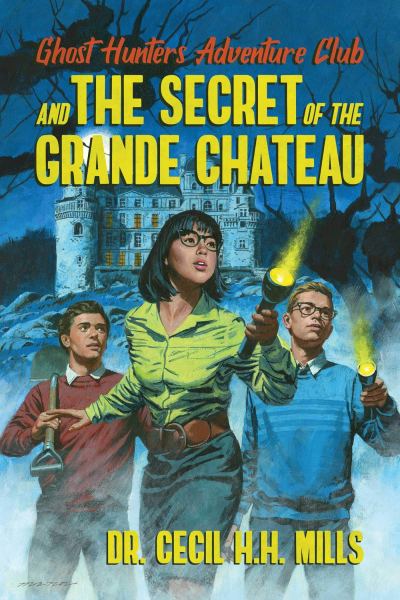 I’ve been watching the Game Grumps since 2015, or so, and I enjoy their content quite a bit. In a way, they remind me of Mystery Science Theater 3000, but instead of riffing on films, they’re riffing on video games. Arin Hanson and Dan Avidan have a great rapport together and it’s a joy to watch their videos. Why do I bring this up? Because Ghost Hunters Adventure Club and the Secret of the Grande Chateau is the “first official novel from Game Grumps.” Yes, it seems after branching into video games, the duo are branching into the literature world. So, as a fan of Game Grumps, I knew I wanted to give this book a read. But everything about its promotion felt really… strange. It seems pretty obvious that the novel is actually authored by Arin Hanson, yet it’s credited to a Cecil H.H. Mills, a man whom Arin claims is his uncle (but is obviously just Hanson in a wig and some makeup). Everything about the book’s promotion felt like one of Game Grump’s extended bits and, as a lover of books, it made it kind of difficult to get excited for this novel as I could never tell if it was something serious or just a joke. And, having now read the novel, I’m still not sure if it’s meant to be taken seriously. If it’s supposed to just be a bit of fun that satirizes Nancy Drew/Hardy Boys books and does a bit of fun character work with Cecil H.H. Mills, it’s pretty solid. But if it’s meant to be taken even a little bit seriously, it’s a really rough read. (Mild spoilers follow).)
 Thoroughly Modern Reviewer