
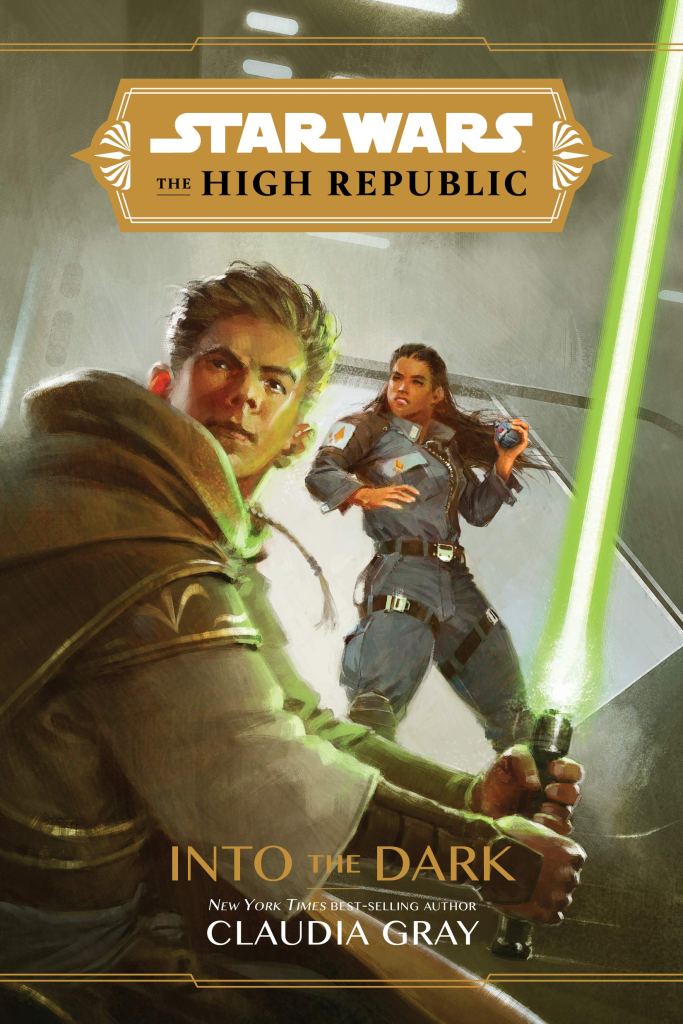
It’s great that Disney is finally starting to expand the Star Wars universe past the confines of The Skywalker Saga and the time frame it’s set in. I’ve always believed the Star Wars universe was one rife for exploration, and what better way of exploring new aspects of it than with a big, multimedia event? That’s exactly what Disney and Lucasfilm are doing with The High Republic, a multi-media publishing event spanning novels and comics. Set some 200 years before The Phantom Menace, The High Republic looks to explore a new corner of the galaxy’s history—and that’s exhilarating. While the first few titles of this event came out last month, I haven’t read any of them. Instead, I wanted to start my High Republic journey with Claudia Gray’s entry—the YA novel, Into the Dark. Gray is one of my favorite Star Wars authors and the book’s synopsis had a very claustrophobic Alien vibe. So, I was pretty excited to read it. And, having read it, it lives up to my expectations. Star Wars: Into the Dark is an exhilarating, character-driven story that deftly explores this new era. It’s a quick-paced, satisfying read, and I’m eager for more. (4.5 out of 5 wands.)
NOTE: I received an ARC from NetGalley in exchange for an honest review. All opinions are mine. Additionally, this review will be as spoiler free as possible.
Continue readingStar Wars: Into the Dark (The High Republic) by Claudia Gray
Padawan Reath Silas is being sent from the cosmopolitan galactic capital of Coruscant to the undeveloped frontier—and he couldn’t be less happy about it. He’d rather stay at the Jedi Temple, studying the archives. But when the ship he’s traveling on is knocked out of hyperspace in a galactic-wide disaster, Reath finds himself at the center of the action. The Jedi and their traveling companions find refuge on what appears to be an abandoned space station. But then strange things start happening, leading the Jedi to investigate the truth behind the mysterious station, a truth that could end in tragedy…


 One of the things I’ve most wanted from a Star Wars story was something that felt similar to Firefly. There’s just something I find endlessly fascinating about watching a group of loveable outlaws struggles against an oppressive government. That’s exactly what Firefly excelled at and it would seem that the Star Wars universe would be perfect for such a story. And for a long time, George Lucas was working on a show that explored the underworld of the Star Wars universe, but it was ultimately deemed too expensive to do in the latter half of the first decade of the 2000s and was completely shelved when Disney bought Lucasfilm. A glimpse of hope seemed to shine, though, when the first trailers for The Mandalorian hit the internet and it genuinely seemed as though The Mandalorian might be the show I was longing to see. You had the leader, Pedro Pascal’s unnamed Mandalorian, appearing to assemble some kind of crew to accomplish some kind of mission. Unfortunately, the actual show we got was less Firefly and more Saturday morning cartoon. Is this necessarily a bad thing? No, but it probably shouldn’t have been advertised as anything more than that. Regardless, there’s a lot of enjoyment to be found in The Mandalorian, even if it is often poorly paced, seemingly aimless, and occasionally frustrating to watch. (Spoilers for all eight episodes of The Mandalorian’s first season.)
 Oh, Star Wars. Is it the curse of nearly every Star Wars film made after 1983 to be extremely divisive? While I wasn’t one of the people who abhorred The Last Jedi, I also wasn’t one of the people who adored it. There were some solid ideas (that, admittedly, weren’t executed very well) mixed in with some less-than-stellar ideas, and the movie didn’t really do a great job at setting up the final film in the trilogy – which, really, is the entire purpose of a trilogy’s middle film. So, in the wake of all of that, was it ever really possible for The Rise of Skywalker to actually be very good or remotely satisfying? I’d argue it wasn’t, which is exactly the mindset I went into this movie with. Somehow, I was still disappointed, though. In fact, Star Wars: The Rise of Skywalker is a deeply frustrating film. In trying to please everybody, it pleases nobody. It tries to cram too much plot, and too much poorly-thought-out fan service into too little a runtime to make something remotely interesting. (Very mild spoilers may follow; you’ve been warned.)
 At San Diego Comic-Con this past weekend, Disney/Marvel announced the slate of titles making up Phase Four of the MCU. Among the titles announced are five films – Black Widow, Eternals, Shang-Chi and the Ten Rings, Doctor Strange in the Multiverse of Madness, and Thor: Love and Thunder – and five Disney+ shows – Falcon and the Winter Soldier, WandaVision, Loki, What If?, and Hawkeye. Some of these movies/shows seem interesting, others I don’t know enough about yet; but, overall, I found it rather hard to get excited for any of them as it all just sort of feels like an endless onslaught of similar-looking and feeling blockbusters that slowly erode any innovation within the artform. I wasn’t the only person with a take like this and, as you’d expect, there were some MCU-fans pretty unhappy with those who were less-than-enthusiastic about the news. One such fan replied to a pretty popular (progressive) YouTuber’s tweet, suggesting that the mixed reaction was partially in response to the Phase Four lineup consisting of films that focused on women/people of color/LGBTQ+ characters more than previous MCU films have. This accusation leveled at this particular YouTuber was a bit ludicrous as this YouTuber has long championed diversity in films, but it did lead to a conversation about how viewing Disney films has turned into a bit of a moral stance, often pushed by Disney’s own PR team. The idea goes that by watching one of Disney’s films featuring progressive ideas (such as having a diverse cast), you’re taking a moral stance in support of an issue rather than just giving your money to a corporation that doesn’t really care about these issues you care about. It’s an interesting conversation, and a kind of funny one, especially in light of Disney’s long history of immorality. (A quick note – I am not trying to insult or criticize anyone who is excited about any of Disney’s upcoming films, nor am I trying to insult or criticize anyone who really enjoys these movies. What I am trying to criticize is Disney’s framing of the viewing of their films as a moral statement while they do very immoral things as a company.)
 In news that will surprise exactly nobody: I didn’t like this remake of The Lion King. I historically haven’t liked any of the recent Disney “live-action” remakes, but I dislike this one for reasons that are different to why I didn’t like the others. But first, it’s important to note that I was never on the hype train for the original version of The Lion King. Sure, it’s a wonderfully enjoyable movie with a killer soundtrack, but it wasn’t notably better than any of the other films from that era of the Disney Rennaissance. It had all the usual problems found in those movies: odd pacing, a saggy middle, and supporting characters and villains that ended up far more interesting than the main character. But it was still very well done, featured some stellar animation, and was full of heart. All of what made the original Lion King a classic is gone in this photo-realistic CGI remake (I refuse to call it a live-action remake because none of this movie was filmed live; it was all done in a computer so it’s every bit as animated as the original version was, just with a different form of animation). Instead, we’re left with some pretty impressive looking CGI animals that are devoid of any life or heart and a movie that hews so closely to the original that it begs the question: why bother making this at all?
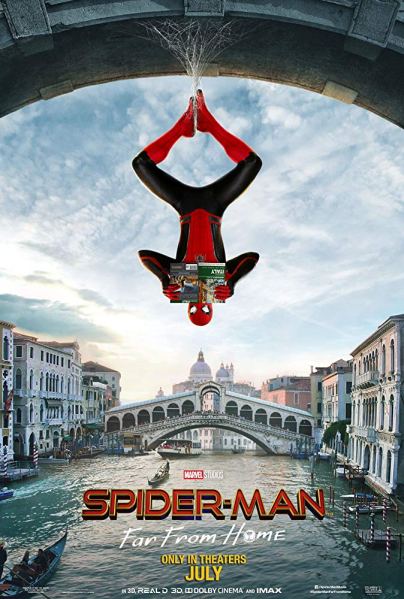 It’s not exactly a secret that I’m not the biggest fan of the MCU. It’s not that I have anything against the series as a whole, and I’ve quite liked a number of the movies, but a much larger number of them tend to be exceedingly mediocre movies. There’s nothing wrong with a movie that’s just “okay” – but when it’s film after film after film that all feel the same and don’t aspire to be much better than simply “fine”, it can get really exhausting very quickly. There’s really only one or two MCU movies that I thought were actually bad (Civil War and Endgame), but both of them were huge team-up movies. I tend to have nicer thoughts for the solo films. As for this iteration of Spider-Man, well… I didn’t love his appearance in Civil War and Homecoming‘s tone felt a bit too ’80s-teen-movie at times for my tastes, but he’s a solid character and Tom Holland is doing a very good job with his portrayal and the character has some of the best villains in the entire Marvel universe (and Homecoming’s usage of The Vulture was very good), so I have more positive thoughts about Spider-Man than I do for some other MCU movies. So, with the upcoming release of the newest Spider-Man movie, Far From Home, it’s time to see what’s next for Spider-Man in the aftermath of Avengers: Endgame. Is this movie better than Endgame was? Answer: Yes, but that’s not exactly a high hurdle to clear – and Far From Home barely clears it. (This review will be as spoiler-free as possible, but if you don’t want to know anything about the movie, this is your warning.)
 Thoroughly Modern Reviewer