
 I really wish Doomsday Clock was better than it is. I love Alan Moore and Dave Gibbons’ Watchmen and I really enjoy the DC Universe; I even thought much of the lead up to this series was very good – or, at least, intriguing. But then the actual series came out and it was plagued by so many delays in its publication that it genuinely became difficult to follow the story as it went on. Unfortunately, rereading the whole series upon its completion didn’t really make it much easier to follow. But, I suppose, that’s in line with the original Watchmen graphic novel. (This review covers all twelve issues of Doomsday Clock and may contain mild spoilers.)
Doomsday Clock (written by Geoff Johns, illustrated by Gary Frank)
Seven years after the events of Watchmen, Adrian Veidt has been exposed as the murderer of millions. Now a fugitive, he has come up with a new plan to redeem himself in the eyes of the world. The first step? Finding Dr. Manhattan. Alongside a new Rorschach and the never-before-seen Mime and Marionette, he follows Manhattan’s trail to the DC Universe, which is on the brink of collapse as international tensions push the “doomsday clock” ever closer to midnight. Is this all Dr. Manhattan’s doing?Spinning out of Watchmen, DC Universe: Rebirth, and Batman/The Flash: The Button, Doomsday Clock rewrites the past, present, and future of the DC Universe.
 I don’t normally review YA novels for the sheer fact that they so rarely appeal to me. I’m not a huge fan of a lot of the typical fare they cover (teenage drama, lots of romance, etc) so I tend to stay away from them. But I’ve read some of Daniel Kraus’ previous work, the most recent being his adaptation of The Shape of Water, and really enjoyed it. So, when I saw that he had a new book coming out and read the book’s synopsis, I was definitely intrigued. It sounded like the kind of thing that might be right up my alley (being an avid lover of Science Fiction and Horror), so it seemed like a fun book to look into. Having now finished it, I can say that it was a good decision on my part. It’s a really well-written story that does its damndest to defy the normal constraints of its genre. I really enjoyed it and I think it’ll be a good read for a number of different audiences – including, but not limited to, the YA crowd. (Mild spoilers may follow.)
 I read this play, and the “memoir” it was based on, a few years ago, when the Sean Hayes production was making its way (back) to Broadway. It was a delightfully charming play; short, effective, hilarious. As is often the case when I read a good play, I found myself longing for it to be filmed and released in some manner – just so I could see and hear Sean Hayes reading this engaging dialogue. Imagine my surprise when, three years later, I heard Audible was going to turn it into one of their Audible Originals, bringing Sean Hayes back into the fold and finally recording this fantastic play so those who couldn’t make it to Broadway (or LA, where Hayes had previously done the show) could hear his take on it. And, I gotta say, it’s so nice getting to hear these words read aloud. (This review will cover both the script itself and the Audible adaptation.)
 I love it when elements of Classic Who and New Who are combined to tell a whole new story. With a history this vast Doctor Who is a franchise that’s perfect for such a mashup of the old and new. Especially given how much of a mixture of old and new this current era is – what with its female Doctor and its throwback to a three-companion TARDIS team. So, when the news broke that Sophie Alfred, the actress who played Ace (companion of the 7th Doctor and the prototype for the modern Doctor Who companion as we know them), would be writing a book detailing an adventure where Ace meets the current Doctor and her companions, I was totally on board. And, I gotta tell you, it’s a really good book. In fact, it’s so good that I wish it could be adapted into an episode or two of the show itself. (Mild spoilers follow.)
  I’ve said it before and I’ll say it again: short stories are a great medium for Doctor Who tales. They provide authors with a nice ability to tell the kinds of stories that maybe wouldn’t quite work as an episode of the show and are too short to support an entire novel. Some of the most creative Doctor Who adventures have come from these collections of short stories (see the recently published Target Collection for examples) and I always look forward to them when they come out. Star Tales is no exception, especially as it finally unveils some of the stories behind the Doctor’s frequently referenced encounters with celebrities. This go ’round, we get our first collection of stories that primarily focuses on the Thirteenth Doctor and her companions – Ryan, Yaz, and Graham – save for one story, early on. How are the stories in this collection? They’re pretty good and definitely worth reading if you’re a fan of this era of the show. (Mild spoilers for the stories within Star Tales.)
 As evidenced by my weekly coverage of the American Gods TV series when it airs, I adore the book, originally written by Neil Gaiman. It’s one of those books that’s super weird and truly hard to explain and honestly just needs to be experienced. But, sometimes it can be hard to find a swatch of time with reach to read a 600+ page novel. Which is where visual adaptations come in. Obviously, they can, and should, never be replacements for reading the original text, but they can often be a great way of experiencing a story you might otherwise not have the time to experience. Unfortunately, Starz’s television adaptation continues to both stray from the source material and be plagued by behind-the-scenes troubles. Luckily, Dark Horse Comics’ has an adaptation of their own. Helmed by P. Craig Russell, these three volumes have been a very faithful adaptation of the novel and an utter joy to read as they’ve released. Now, with the publication of the third and final volume of the adaptation, it’s nice to have a fully-completed, semi-visual adaptation of the novel – if you consider a graphic novel to be a visual adaptation; I do. (Mild spoilers for both the original novel and the graphic novel.)
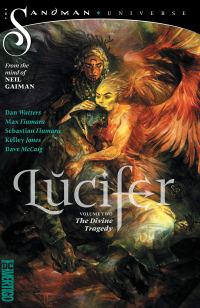 Lucifer is such an interesting character, not just in The Sandman Universe, but in general, and I’m quite a fan of stories that portray the character as something more than just an ultimate prince of darkness, but one with true nuance who might actually have a point in his ongoing feud with God. This has always been what DC has done with this version of the character, originally developed by Neil Gaiman, then further developed by Mike Carey, and now written by Dan Watters. As evidenced by the previous volume, Watters has an excellent grasp on what makes Lucifer a compelling character – imbuing this version with lots of vulnerabilities to go along with his massive amounts of power. In this volume, we get a direct continuation of the previous volume, furthering the story of the Morningstar and his newly-discovered family. It’s a great continuation of that storyline and a really great comic in its own right. (Mild spoilers for Lucifer: The Divine Tragedy follow!)
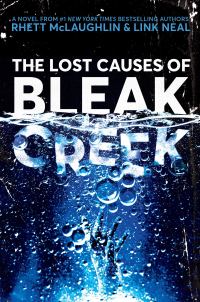 I’ve been a fan of Rhett and Link’s for a while now. Their content is so wholesome and enjoyable – and they grew up fairly close to where I live – so it’s hard for me not to enjoy their stuff. My love of Rhett and Link is what led me to their first novel, The Lost Causes of Bleak Creek. Were it not to have been written by them, it likely would have never made its way onto my radar. But, with its connection to these YouTubers, I eagerly awaited the publication of the book, unsure of exactly what to expect. Well, having read The Lost Causes of Bleak Creek definitely feels like a first novel. And I don’t really mean that as an insult, but an author’s first novel is often very imperfect and that’s exactly what The Lost Causes of Bleak Creek is – imperfect. There are a lot of really good ideas and characters scattered throughout the book, but it’s all a bit hampered by too-few pages and uneven pacing. (Mild Spoilers for The Lost Causes of Bleak Creek follow.)
 Last year, the Target line of Doctor Who novelizations burst back to life with the first adaptations of episodes from the revived TV series –
  As I said in my review of the first volume of this new run of The Dreaming, one of my favorite things about Neil Gaiman’s original Sandman run was the way the comic’s story was partially about the very nature of stories. Gaiman played with various structures to examine the fabric of storytelling and why it’s always been such an effective means of communication. Everything else was the icing on this theme of a cake. This examination of storytelling is one of the key things that brings readers back to those comics time and time again. Simon Spurrier continued this approach in the first volume of his run on The Dreaming, and he continues it in this next volume – a volume that helps bridge the story of The Sandman with this new story being told here. It’s a really good graphic novel.
 Thoroughly Modern Reviewer